Think of a streaming service listing movies down the side and users across the top. A user–item interaction table records what each user does with each item in the cell where their row and column meet. Most cells are empty because users interact with only a fraction of available items. section 2.3.2
Simple calculations on the table can suggest recommendations from past interactions or item similarity. The approach can work across unrelated items, but a very large table can be difficult to update and use. It also leaves out context such as location or day of the week. section 2.3.2
Figure 2.7 An example of a user-item matrix for collaborative filtering. Each cell records the rating of each user for the corresponding item. Note that, in general, users don’t interact with all the items.
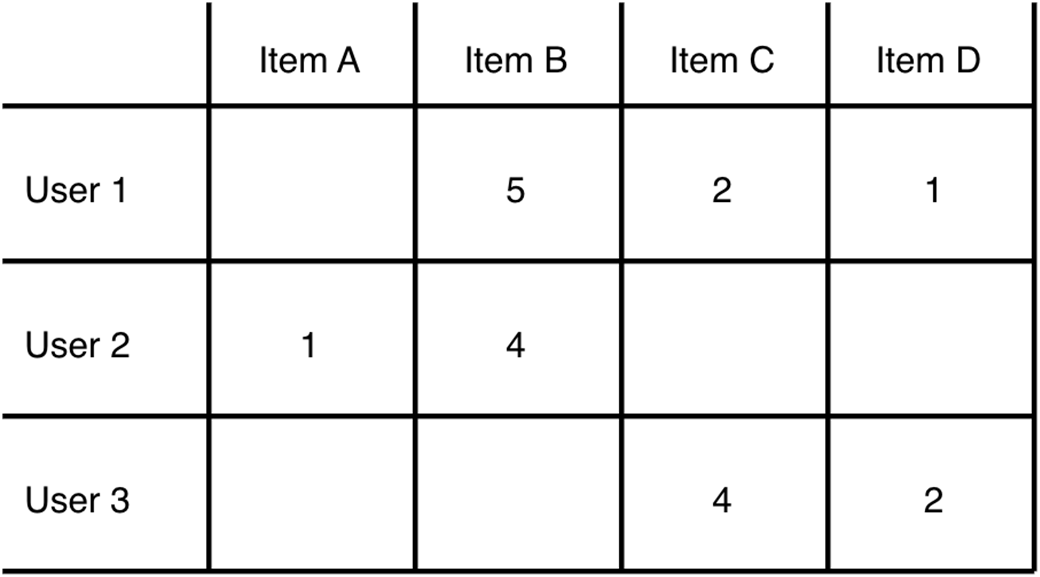
The figure shows users as columns, items as rows, and ratings in the cells; many cells are blank. section 2.3.2
