A beta-sheet is a protein secondary structure in which extended beta-strands align laterally and connect through hydrogen bonds between their backbones. Individual beta-strands are unstable alone, so sheet formation provides the relevant structural context. section 12.1.1
Unlike alpha-helices, paired strands may be far apart in the primary sequence. Predicting a beta-sheet therefore requires recognizing distant sequence segments that adopt extended conformations and pack together in three-dimensional space. section 12.1.1
Distant strands forming one sheet
A strand spanning residues 20–27 may hydrogen-bond with another spanning residues 95–102. Their separation makes local sequence-pattern methods inadequate and highlights the need to model long-range dependencies. section 12.1.1
Figure 12.3 Primary structure is the linear sequence of amino acids. Secondary structure is local backbone geometry—chiefly alpha-helices and beta-strands—stabilized largely by backbone hydrogen bonding. Tertiary structure is the full three-dimensional arrangement of a single polypeptide chain, including how its secondary-structure elements and connecting loops pack together. Quaternary structure describes an assembly of more than one chain.
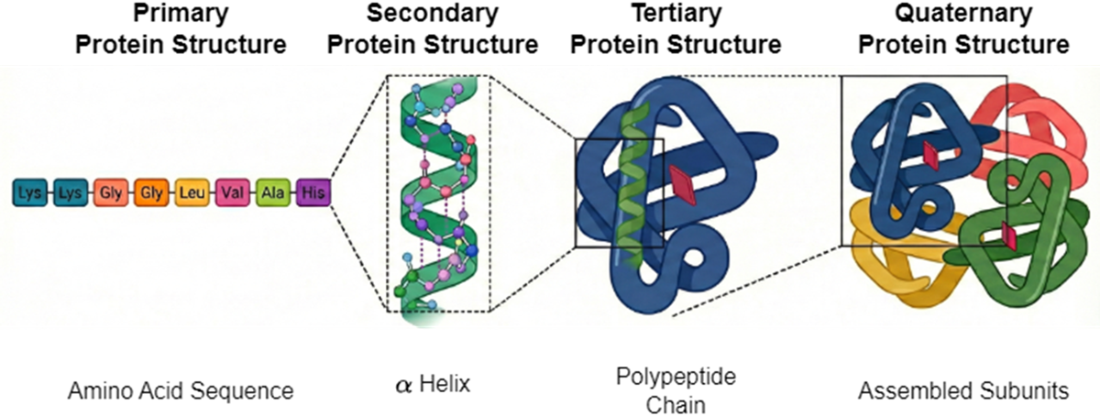
Use the structural hierarchy to relate beta-sheets to primary sequence, secondary structure, tertiary folding, and quaternary assemblies. section 12.1.1
