A beyond-accuracy metric evaluates recommendation qualities that relevance and ranking metrics cannot capture. It asks whether recommendations reach different users, cover the catalog, vary within a list, or surface unexpected items. section 4.1.3 section 4.6
Use beyond-accuracy metrics to expose weaknesses that strong precision or ranking scores can hide:
- User coverage measures performance across user segments, revealing whether cold-start users receive useful personalization or generic fallbacks. section 4.6.4
- Item coverage measures the fraction of the catalog that appears in anyone's recommendations, exposing popularity bias and long-tail invisibility. section 4.6.4
- Diversity measures variety within one user's list; recommending different facets of an interest can be more useful than repeating highly similar items. section 4.6.4
- Serendipity captures surprising recommendations that accuracy-focused systems may never surface. section 4.6 section 4.6.4
Diagnosing catalog concentration
An ALS model recommends only 2.6% of the catalog, with more than half of those items from the most popular quartile. Comparing this result with a popularity baseline helps identify whether personalization is narrowing exposure rather than expanding it. section 4.6.4
Figure 4.18 ALS recommends only a small percentage of available items.
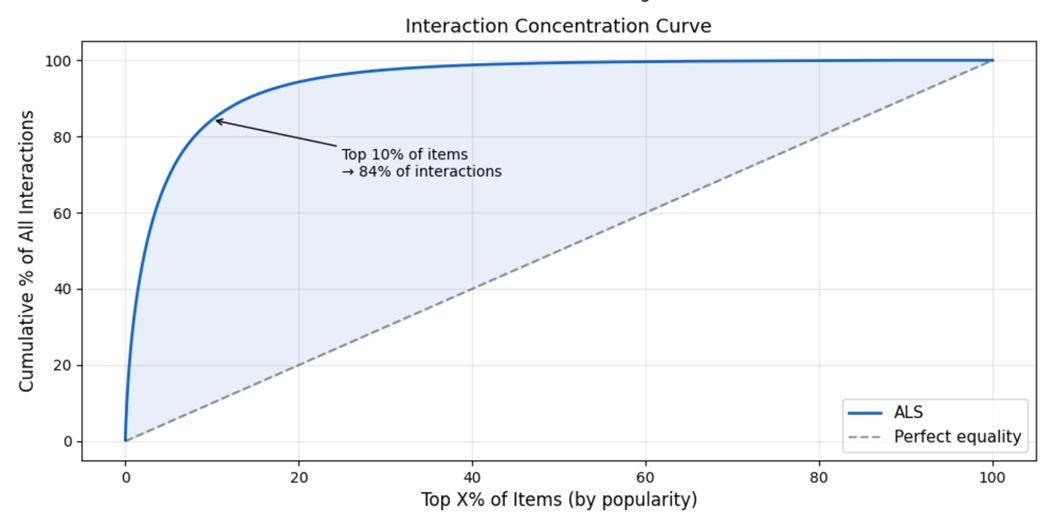
Inspect the catalog-coverage visualization to see how a recommender can concentrate exposure in a small portion of available items. section 4.6.4
