Big-endian stores the most significant byte of a multi-byte value first and the least significant byte last. For a 32-bit value, this places the highest-order bits at the lowest memory address. section 7.3
32-bit representation
The value 0xE011CFD0 is stored in big-endian order as the consecutive bytes 0xE0, 0x11, 0xCF, and 0xD0. Little-endian reverses that byte sequence. section 7.3
Big-endian matters when values cross memory, serialization, and network boundaries:
- CPU architecture determines the in-memory byte order of multi-byte values. section 7.3
- Many network protocols use big-endian as network byte order, despite little-endian being common on modern ARM and x86 CPUs. section 7.3
- Serialization and deserialization must transform values accurately between in-memory and external representations. section 7.3
Figure 7.2 Serialization transforms the in-memory representation of data (shown on the left as a Rust struct) to a serialized format such as JSON (shown on the right). Deserialization performs the opposite transformation from a serialized format to an in-memory representation.
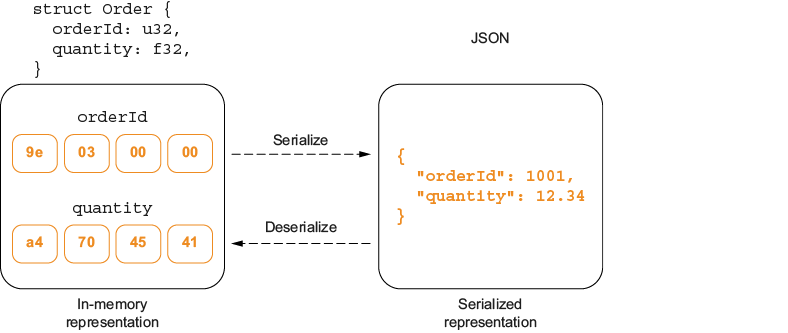
Use the serialization diagram to relate byte-order decisions to transformations between in-memory data and formats such as JSON. section 7.3

