A binary-coded genetic algorithm (BGA) is a population-based search method in which each candidate solution is a string of 0s and 1s. The bits encode decision variables; an objective function scores each decoded candidate. Selection, crossover, and mutation then produce candidates for another generation. Ticket pricing is a simple application: search for a price that maximizes profit while respecting a permitted price range. section 7.0 section 7.3.2 section 7.4
Five possible ticket prices
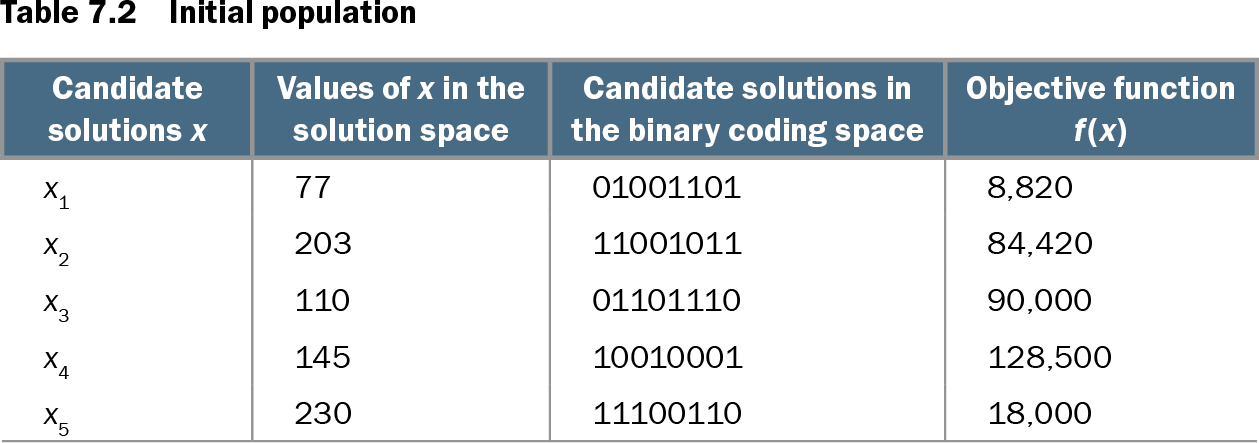
Suppose the permitted price is $75–$235 and profit is −20x² + 6200x − 350000, where x is the ticket price. With whole-dollar prices, an eight-bit chromosome can hold each candidate: 77 becomes 01001101, while 145 becomes 10010001. Score the decoded prices by profit rather than by their bit patterns. Precision matters: representing steps of $0.10 across this range calls for more bits than the eight used for whole-dollar prices. section 7.3.2 section 7.4
Table 7.2 Initial population (view table figure)
| Candidate solutions x |
Values of x in the solution space |
Candidate solutions in the binary coding space |
Objective function f(x) |
|---|---|---|---|
| x1 |
77 |
01001101 |
8,820 |
| x2 |
203 |
11001011 |
84,420 |
| x3 |
110 |
01101110 |
90,000 |
| x4 |
145 |
10010001 |
128,500 |
| x5 |
230 |
11100110 |
18,000 |
The initial population pairs five prices with their eight-bit chromosomes and profit scores, making the encoding-to-fitness step concrete. section 7.3.2
A small Python implementation follows this loop:
- Generate a population of prices within the permitted range, convert each to binary, and pad chromosomes to a common length. section 7.4
- Decode each chromosome, calculate profit, and select parents. The implementation shows random selection and a fitness-weighted roulette-wheel alternative. section 7.4
- With a chosen probability, cross two parents at a point; mutation flips selected bits. Repeat for a set number of generations, recording the best score. section 7.4
In the worked Python run, a population of five evolves for 1,000 generations with crossover probability 0.7 and mutation probability 0.3; the reported best price is $155, yielding $130,500 profit. Treat those settings as an experiment, not a universal recipe. Binary encoding also has a locality drawback: changing a significant bit can cause a large change in the decoded value, a Hamming cliff. Gray-code or real-valued encoding offers alternatives when that disruption matters. section 7.4 section 8.1 section 8.9