Binary quantization compresses each embedding feature into a single bit, usually 0 or 1. It reduces vector storage and similarity-computation cost, trading some initial recall for faster, smaller vector search. section 13.7 section 13.7.2
A threshold assigns the bit: values on one side become 0 and values on the other become 1. A zero-centered threshold can work when feature values are evenly distributed; per-feature medians or similar thresholds help with non-uniform distributions. Model-based binary representations can preserve meaning better by learning the encoding from the full input context. section 13.7.2
A practical binary-search pipeline typically:
- Quantizes document embeddings and stores them as unsigned binary values. section 13.7.2
- Builds a binary index and searches it with similarly quantized query embeddings, calibrated against document embeddings when needed. section 13.7.2
- Reranks the strongest candidates with full-precision vectors to recover recall and improve final relevance. section 13.7 section 13.7.5
FAISS benchmark
A FAISS binary index reduced search time by 83.38% and index size by 96.87%; initial recall was 0.6044, while reranked recall reached 1.0. Combining binary quantization with IVF, reduced-dimensionality embeddings, and reranking produced a 99.09% faster search, a 98.22% smaller index, and 0.7244 reranked recall. section 13.7.2 section 13.7.5
Figure 13.9 Quantizing data: full precision, reduced scalar precision, and binary precision
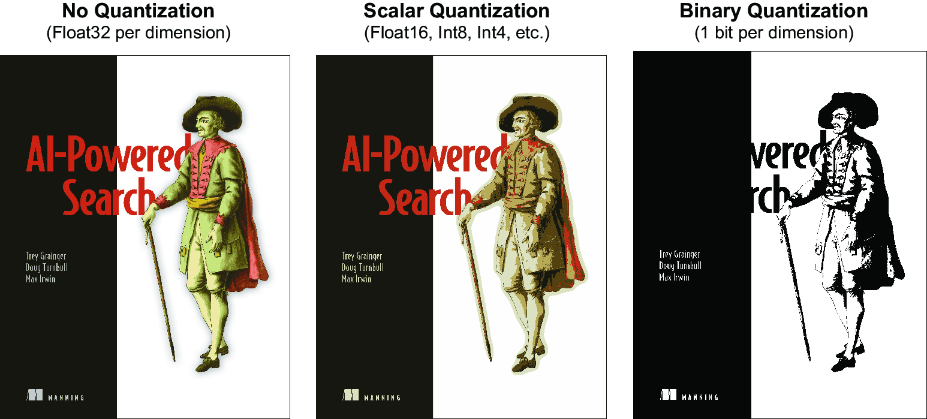
Compare full-precision, scalar, and binary representations visually before choosing a compression level. section 13.7
