liveBook · Manning

Bit per second

As explained in Acing the CCNA Exam: Volume 1 Fundamentals and Protocols

A bit per second is a unit of data transmission rate representing one transmitted bit per second.

A bit per second (bps) measures data transmission rate: one bit transmitted each second. Network speeds use larger decimal units because modern connections transmit many bits. section 3.2

Know these common rate units:

  • 1 kilobit (kb) = 1,000 bits; 1 megabit (Mb) = 1,000,000 bits. section 3.2
  • 1 gigabit (Gb) = 1,000,000,000 bits; 1 terabit (Tb) = 1,000,000,000,000 bits. section 3.2
  • Do not confuse bits with bytes: a byte contains 8 bits. Base-2 quantities use kibibit, mebibit, gibibit, and tebibit instead. section 3.2 section 3.5

Reading a network rate

A connection rated at 100 Mbps transmits 100 million bits per second. Other common labels include 56 kbps, 10 Gbps, and 1 Tbps. section 3.2

Figure 3.1 A router sends 1 byte of data to a switch. Changes in the voltage of the electric signal indicate values of 0 or 1.
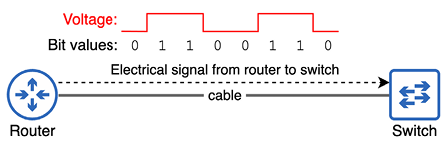
Visualizes a router sending a byte as voltage changes representing binary 0 and 1. section 3.2

How Acing the CCNA Exam: Volume 1 Fundamentals and Protocols covers it

How deep it goes
Defines transmission-rate units and conversions, while stopping short of detailed throughput or performance analysis.
Examples
Uses 56 kbps, 100 Mbps, 10 Gbps, and 1 Tbps as representative network-rate labels.
What it assumes
Starts with the meaning of a bit and byte, requiring no prior networking background.
What you can do after
Evaluate network-speed labels and distinguish decimal bit units from binary information units.
How it connects
Connects bits per second with bits, bytes, binary notation, and Ethernet network speeds.

This explainer was generated by Manning's knowledge graph from the text of Acing the CCNA Exam: Volume 1 Fundamentals and Protocols. The section links point to the parts of the book it draws on.