liveBook · Manning

BitLinear

As explained in Domain-Specific Small Language Models

A component that replaces traditional linear layers in BitNet and enables training and inference with 1-bit weights.

BitLinear replaces traditional linear layers in BitNet, enabling 1-bit weights while retaining higher precision elsewhere to reduce model cost and energy use. section 9.3

Operationally, BitLinear supports:

  • Replacing linear layers in BitNet attention and feed-forward components. section 9.3
  • Replacing linear layers in Hugging Face and ordinary PyTorch models through dedicated helper functions. section 9.4
  • Keeping input/output embeddings and sampling probabilities at higher precision while binarizing attention weights. section 9.3

Replacing a model's linear layers

Load a pretrained model, call replace_linears_in_hf(model) for a Hugging Face model or replace_linears_in_pytorch_model(model) for a PyTorch model, then run inference normally. section 9.4

Figure 9.4 The BitLinear component (left) and the BitNet architecture (right)
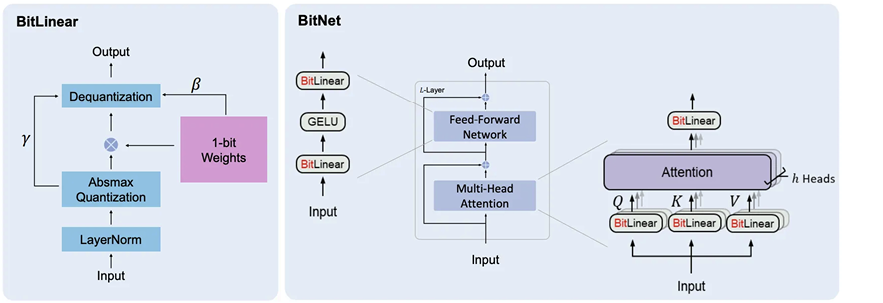
Use the architecture diagram to compare the BitLinear component with its placement in BitNet's Transformer layout. section 9.3

How Domain-Specific Small Language Models covers it

How deep it goes
Explains 1-bit attention weights and precision boundaries, but does not detail the underlying quantization equations.
Examples
Uses BitNetTransformer definitions, Hugging Face GPT-2 conversion, PyTorch Sequential conversion, and inference pipelines.
What it assumes
Assumes familiarity with PyTorch models and Hugging Face model loading while demonstrating layer replacement from existing models.
What you can do after
Apply it via Python APIs to replace linear layers and run inference with converted PyTorch or Hugging Face models.
How it connects
Connects BitNet with Transformers, attention, quantization, PyTorch, and Hugging Face Transformers.

Related concepts

This explainer was generated by Manning's knowledge graph from the text of Domain-Specific Small Language Models. The section links point to the parts of the book it draws on.