Blind testing evaluates a classifier with test utterances it has not seen in training. This reveals whether it can recognize users’ intents beyond memorized examples. section 4.2.1
A blind test can use:
- AI-generated utterances manufactured for testing. section 4.2.1
- Representative utterances collected from actual user logs. section 4.2.1
- Accuracy, recall, and precision scores that show where the classifier succeeds or becomes confused. section 4.2.1
Testing beyond memorized utterances
If a classifier was trained on one phrasing of an intent, blind testing checks whether it recognizes a new phrasing that expresses the same intent. A correct prediction supports the chatbot’s ability to deliver the intended response or invoke the correct process flow. section 4.2.1
Figure 4.5 K-fold cross validation and generated test data are suitable for situations where representative data is not available. Once a solution is deployed to production, representative blind test data will produce the most reliable measurement of your classifier’s ability to understand.
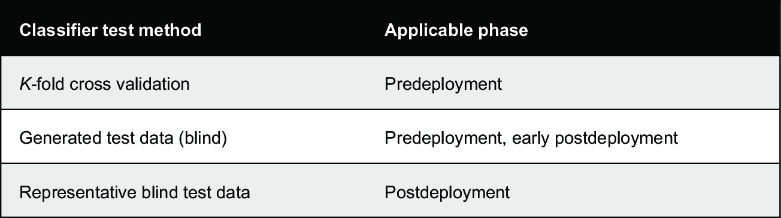
Compare k-fold cross validation and generated test data with representative blind test data, which provides the most reliable measurement after deployment. section 4.2.1
