A block is an immutable unit of blockchain data. It groups transactions or other data with metadata, then links to earlier blocks through a previous hash rather than an ordinary pointer. section 1.6
A JavaScript Block model typically carries:
- An index, timestamp, transaction data, previousHash, and its calculated hash. section 3.5
- A genesis check that recognizes the first block through a repeated-zero previous hash. section 3.5
- Hashing and validation behavior supplied through reusable mixins. section 3.5
- A tamper-evident chain: changing one block requires recomputing its hash and affects the hashes that follow. section 1.6 section 3.5
A block carrying transactions
A payment begins as a pending transaction. After validation, it joins other transactions in a new block, which is appended to the chain and makes the payment complete. section 1.6
Controlled JSON representation
A Block can expose a Symbol.for('toJson') method that serializes its index, previousHash, hash, timestamp, data count, data, and version. A ledger can then serialize each block and combine the results into a buffer. section 7.4.3
Figure 1.13 A simple representation of a blockchain, in which each block stores the previous block’s hash. This hash is used to compute the current block’s own hash, effectively connecting all these blocks in a chain.
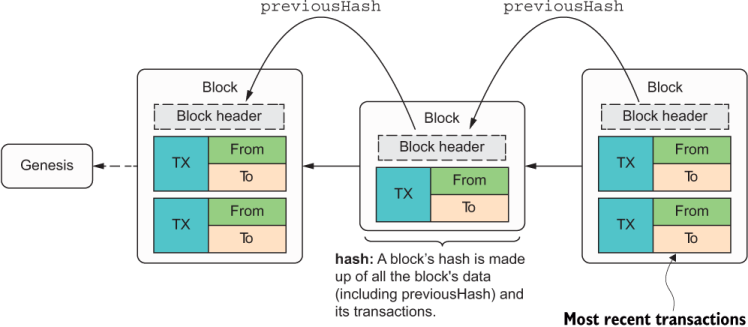
Shows how each block stores the previous block’s hash, allowing the current hash to connect the chain. section 1.6

