A CUDA block’s dimensions specify how many threads it contains along each coordinate axis. For a one-dimensional block, blockDim.x gives the thread count; combined with blockIdx.x and threadIdx.x, it helps each thread find its place in the full grid. section 3.3
Find a thread’s global index
With blockDim.x = 4, blockIdx.x = 3, and threadIdx.x = 2, the global index is 3 × 4 + 2 = 14. Each block covers a contiguous range, so block 2, thread 1 handles index 9. section 3.3
Figure 3.1 Launching <<<3, 4>>>: 12 threads, but only 4 elements touched. With 3 blocks of 4 threads each, every thread uses only threadIdx.x, so all three blocks target the same 4 elements (data[0..3]), leaving data[4..11] untouched. To reach the full array, each thread needs to factor in its block index too.
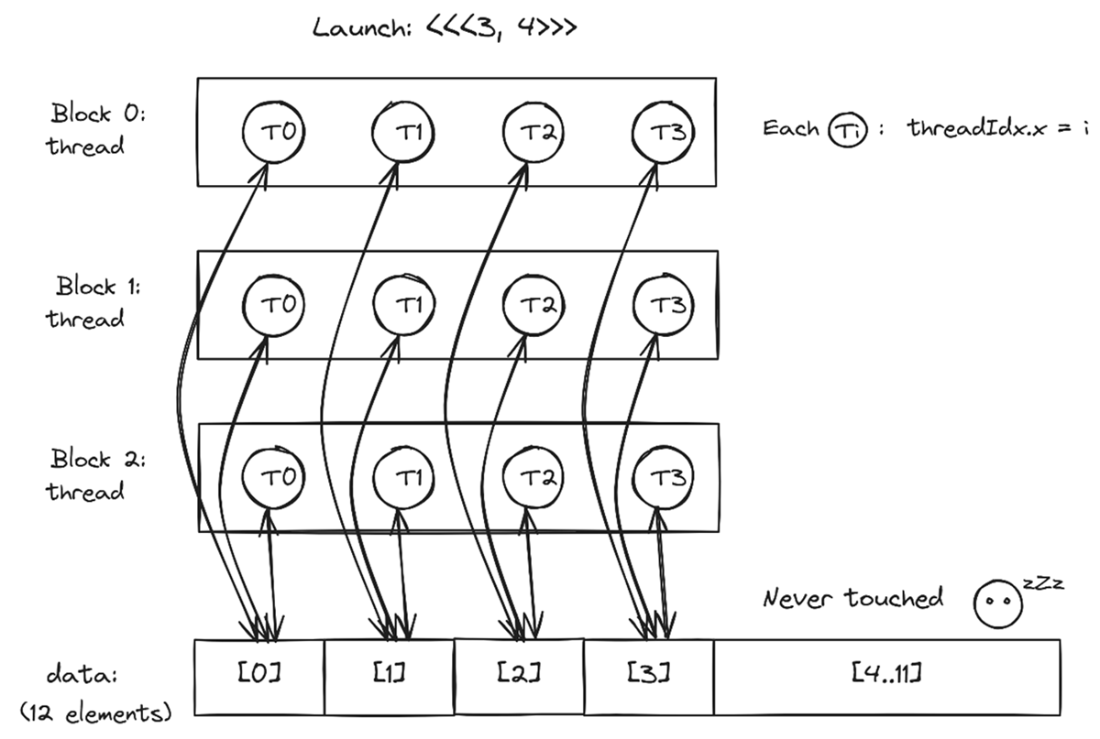
See why using threadIdx.x alone makes blocks target the same elements instead of covering the full array. section 3.3
Block dimensions also need to fit the work assigned to each thread:
- A tiled matrix-multiplication kernel uses a TILE_SIZE × TILE_SIZE block so each thread loads one tile element. A smaller block leaves tile slots unfilled; a larger one risks overlapping or out-of-bounds writes. section 12.4
