The blocking state is a stable Spanning Tree Protocol (STP) port state that prevents Layer 2 loops. A blocked port does not forward normal data frames or learn MAC addresses, but it continues processing STP messages such as BPDUs. The physical link remains available as a backup if an active path fails. section 14.2 section 14.4.1
Use these rules to identify and interpret the state:
- Assign the blocking state to a non-designated STP port; each Layer 2 segment has one designated port, while other candidate ports remain blocked. section 14.3.3
- Prevent broadcast, unknown-unicast, and multicast frames from circulating around redundant links and creating Layer 2 loops or broadcast storms. section 14.6
- Expect a blocked port to show BLK in show spanning-tree output even though show ip interface brief can still report the interface as up/up. section 14.4.1
- Recognize blocking as stable, unlike listening and learning, which prepare a root or designated port to enter forwarding. section 14.4.1
Redundant switch link
Three switches form a physical ring. STP places SW3 G0/1 in the blocking state, so the SW2–SW3 link carries no normal traffic and cannot complete a Layer 2 loop. If another active link fails, STP can use the previously blocked connection. To observe a transition, reenable a port with interface g0/1 followed by no shutdown, then run do show spanning-tree; a port may appear as LIS before becoming BLK, LRN, or FWD. section 14.2 section 14.4.1
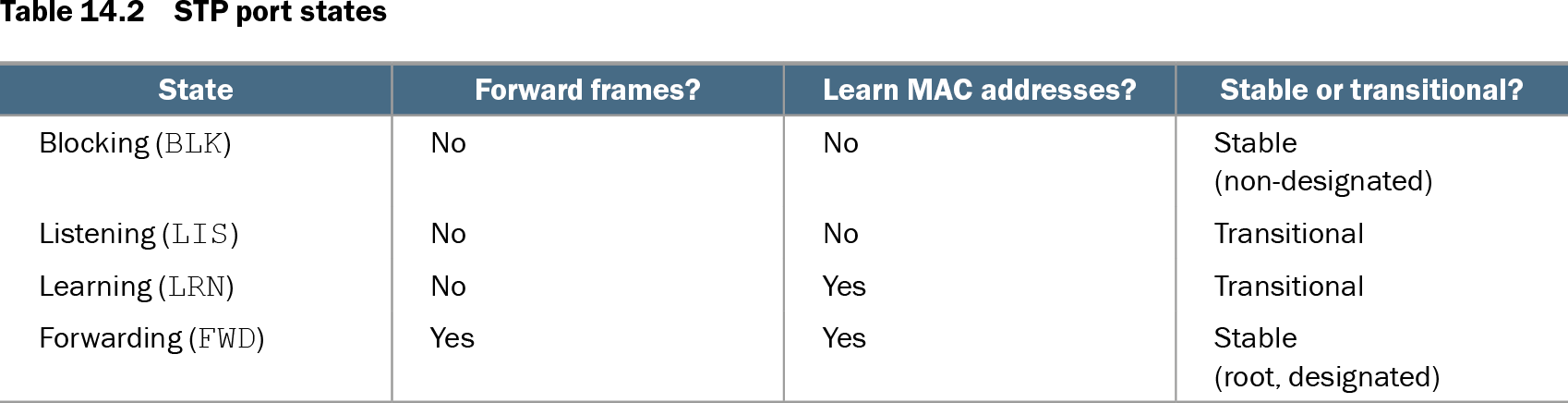
Table 14.2 STP port states (view table figure)
| State |
Forward frames? |
Learn MAC addresses? |
Stable or transitional? |
|---|---|---|---|
| Blocking (BLK) |
No |
No |
Stable (non-designated) |
| Listening (LIS) |
No |
No |
Transitional |
| Learning (LRN) |
No |
Yes |
Transitional |
| Forwarding (FWD) |
Yes |
Yes |
Stable (root, designated) |
Compare blocking with listening, learning, and forwarding by frame forwarding, MAC-address learning, and state stability. section 14.4.1
Rapid STP uses the name discarding state for the combined STP blocking and listening states. An RSTP alternate or backup port normally remains discarding; a root or designated port can move toward forwarding immediately when synchronization succeeds, or follow timer-based transitions when it does not. section 15.2.2 section 15.2.3