liveBook · Manning

Blueprint for an AI Bill of Rights

As explained in Introduction to Generative AI, Second Edition

The Blueprint for an AI Bill of Rights is a United States policy framework describing principles for protecting people in the design and use of automated systems.

The Blueprint for an AI Bill of Rights is a United States policy framework for protecting people when automated systems affect their lives. It offers principles rather than enforceable directives, leaving practical implementation uncertain. section 10.29

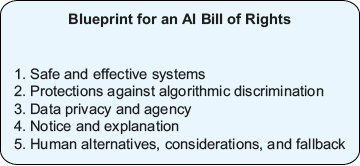
Its five principles call for:

  • Safe and effective systems, supported by evaluation and risk mitigation. section 10.29
  • Algorithmic discrimination protections that identify potential bias. section 10.29
  • Data privacy, including information and agency over data collection. section 10.29
  • Notice and explanation about automated-system use. section 10.29
  • Human alternatives, consideration, and fallback when people opt out or systems make mistakes. section 10.29

The framework remains deliberately broad: it says explanations should be technically valid, meaningful, useful, and calibrated to risk, but does not specify how to implement them. The AI Risk Management Framework later reaffirmed its principles. section 10.29

Figure 10.6 The five principles listed by the OSTP as a “Blueprint for an AI Bill of Rights” [35]
A white card with black text

AI-generated content may be incorrect.

A visual summary of the five principles. section 10.29

How Introduction to Generative AI, Second Edition covers it

How deep it goes
Defines five principles and an explanation standard but stops short of specifying implementation details.
Examples
Uses risk evaluation, bias identification, data agency, automated-system explanations, and human remedies as concrete principle applications.
What you can do after
Evaluate automated-system governance proposals against five rights-oriented principles while recognizing their implementation ambiguity.
How it connects
Connects safe systems, algorithmic discrimination, data privacy, notice and explanation, human fallback, and the AI Risk Management Framework.

Related concepts

This explainer was generated by Manning's knowledge graph from the text of Introduction to Generative AI, Second Edition. The section links point to the parts of the book it draws on.