A simple setting assigns a simple value to a property using the form <property name> = <value>. Simple values include strings, numbers, Booleans, enumerated values, and null for missing or optional content. section 2.1
Naming an object
In an object representing Thing, the setting name="Foo" assigns Foo to the name property. This convention lets you call it the Foo object. section 2.1
Use simple settings to represent:
- Text such as name="Foo". section 2.1
- Numbers, Booleans, and enumerated values. section 2.1
- Missing or optional content represented by null or undefined. section 2.1
Figure 2.2 A simple ORD containing only one object
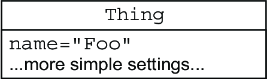
Inspect the single-object diagram that introduces simple settings inside an object. section 2.1
