liveBook · Manning

Simple value

As explained in Building User-Friendly DSLs

A value that is not an object or a collection of objects, including text, numbers, Booleans, and null.

A simple value is anything that is not an object or a collection of objects. Strings, numbers, Booleans, enumerated values, and null qualify; null represents missing or optional content. section 2.1

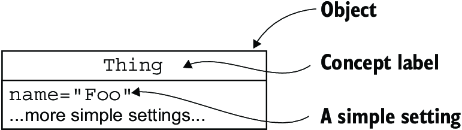
Objects store simple settings such as name="Foo", where a property receives a simple value. The term distinguishes these settings from other kinds introduced later. section 2.1

Figure 2.3 A simple ORD containing only one object, with annotations
figure

Use the annotated object diagram to locate simple settings and their values. section 2.1

How Building User-Friendly DSLs covers it

How deep it goes
Defines the category and lists its cases, but defers other setting kinds to later treatment.
Examples
Uses name="Foo", strings, numbers, Booleans, enumerated values, and null as concrete examples.
What you can do after
Evaluate whether a value belongs to the simple-value category and represent missing content with null.
How it connects
Connects simple values with objects, collections, properties, settings, and null.

This explainer was generated by Manning's knowledge graph from the text of Building User-Friendly DSLs. The section links point to the parts of the book it draws on.