The Boltzmann learning rule is an unsupervised, probabilistic procedure for adjusting neural-network weights so lower-energy states become more likely and the model distribution matches the data distribution. section 8.8 section 8.8.2
The training process combines several ideas:
- Represent the network as a probabilistic recurrent system with stochastic units connected in a fully connected graph. section 8.8.1
- Assign each visible-hidden state an energy E(v,h), then model its probability with a Boltzmann distribution normalized by the partition function. section 8.8.1
- Update weights using the gradient-derived rule: increase visible-hidden co-activation from the data distribution and contrast it with co-activation from the model distribution. section 8.8.1
- Use contrastive divergence when the basic rule is too computationally expensive for practical training. section 8.13 section 8.8.2
Typical uses
Apply the rule to unsupervised tasks such as dimensionality reduction, feature extraction, pattern recognition, optimization, and generative modeling. Lower-energy configurations represent more likely patterns, while higher-energy configurations represent less likely ones. section 8.8.1 section 8.8.2
(8.7)
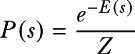
Inspect the energy-based probability equation alongside the weight-update equation to connect state likelihood, energy minimization, and distribution matching. section 8.8.1
