A border point is a non-core observation assigned to a DBSCAN cluster because it lies within ε distance of a core point. section 2.5.2
Use these rules to interpret border points:
- A border point does not satisfy the minPts density threshold required to be a core point. section 2.5.2
- A core point can directly reach a border point, but a border point cannot reach another point. section 2.5.2
- A border point can connect to a cluster through a chain of core points, but it cannot extend that chain. section 2.5.2
- Points that are neither core nor reachable border points remain outliers and receive no cluster assignment. section 2.5.2
Core-to-border reachability
If X reaches core point Y, and Y lies within ε distance of border point Z, Z belongs to the cluster through Y; travel cannot proceed from Z back to X. section 2.5.2
Figure 2.29 Core points are shown as squares; border points are shown as filled circles, while noise is unfilled circles. Together, these three are the building blocks for DBSCAN clustering.
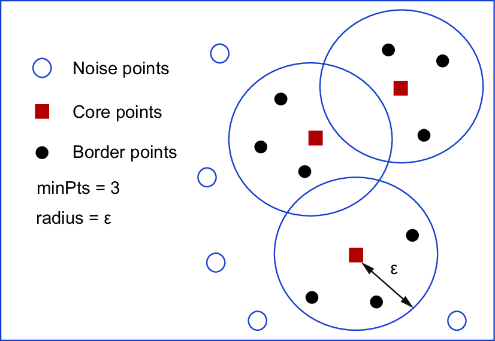
Compare the visual symbols for core points, border points, and unassigned noise. section 2.5.2
