A borrowed bit is a host bit reassigned to the network portion of an IPv4 address during subnetting. Increasing the prefix length creates smaller, separate subnets. section 11.2.1
Use these rules when calculating subnetted address blocks:
- Each borrowed bit doubles the number of subnets: 2^x, where x is the number of borrowed bits. section 11.2.1 section 11.2.2
- Each borrowed bit reduces the host portion and halves the addresses available in each subnet. section 11.2.2
- The borrowed bits become part of the network portion, while the remaining bits identify hosts. section 11.2.1
- Calculate network, broadcast, first usable, last usable, and maximum-host values using the resulting prefix length. section 11.2.2
Borrowing from 192.168.1.0/24
Borrowing one bit changes /24 to /25 and creates two subnets. A borrowed value of 0 produces 192.168.1.0/25; a value of 1 produces 192.168.1.128/25. Borrowing two bits creates four /26 subnets: .0, .64, .128, and .192. section 11.2.1
Figure 11.2 Borrowing 1 bit from the host portion of 192.168.1.0/24 allows us to create two subnets: 192.168.1.0/25 and 192.168.1.128/25. The borrowed bit was part of the host portion of the original address block, but it is part of the network portion of each subnet (as indicated by the /25 prefix length).
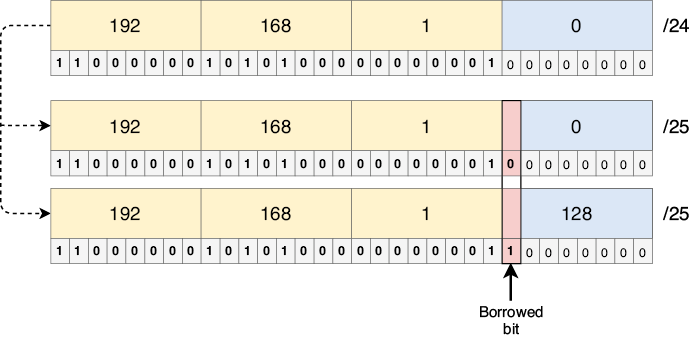
Visualizes how a host bit becomes a network bit when /24 changes to /25. section 11.2.1
