A bounded context canvas is a visual template for examining one subsystem as a whole. It brings its business purpose, responsibilities, strategic role, terminology, rules, and communications into one view so a group can test whether the design is cohesive and loosely coupled. section 12.3.1 section 12.6
Use the canvas to ask:
- Does the name describe a precise responsibility? Generic names can attract unrelated behavior. section 12.3.1
- Do participants agree on the purpose? Ask each person to describe it; differences can expose misalignment. section 12.3.1
- How does the subsystem serve the business strategy, and do its responsibilities and messages fit its stated purpose? section 12.3.1 section 12.6
Payroll workshop
A cross-functional group documenting payroll recorded what belonged inside it, what did not, its main responsibilities, and how it communicated with other contexts. A draft canvas for payslips helped the group reconsider something previously treated as an internal payroll detail. The drafts supported further exploration rather than fixing the architecture at once. section 17.1.1
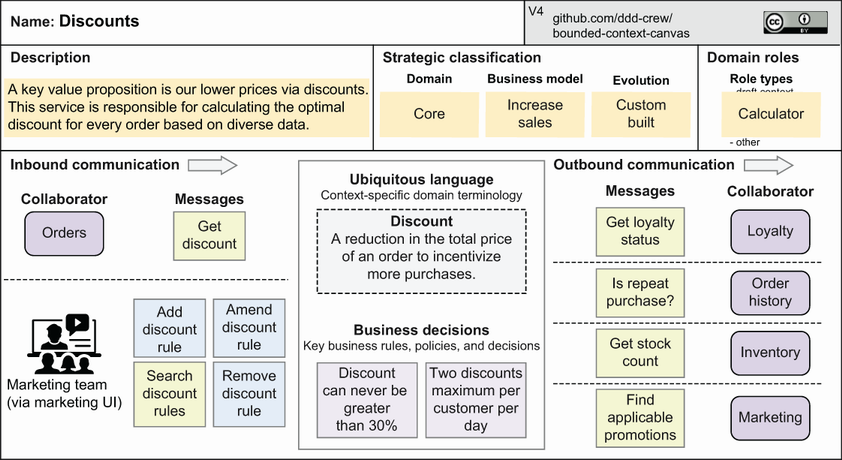
The discounts subsystem canvas shows how the sections combine into one view of a subsystem’s design. section 12.3.1
Treat the canvas as a working model. Revisit it when scenarios reveal inconsistent names, responsibilities, or messages; explore alternatives rather than polishing a diagram too early. section 12.6
