A priority queue may spend much of its time adding items and removing the highest-priority item. In a heap, the branching factor D is the maximum number of children a node can have. A binary heap uses D = 2; a d-ary heap permits a larger value. Changing D is a way to tune the work done by those two operations. section 2.5.5 section 2.9.2
The heap remains a complete, left-adjusted tree: each node has at most D children and has the highest priority in its subtree. It can still be stored in an array. For a three-way heap, node i has children at indices 3i + 1, 3i + 2, and 3i + 3; its parent's index is floor((i − 1) / 3). Thus a wider tree does not require a separate pointer-based representation. section 2.5.5
Figure 2.5 A three-way heap. Only priorities are shown for the nodes (values are irrelevant here). The smaller squares next to the elements show the indices of the heap elements in the array. Top: the tree representation for a min-heap. Notice how every parent is smaller than (or at most equal to) its children and, in turn, all elements in its subtree. Bottom: the same heap in its array representation.
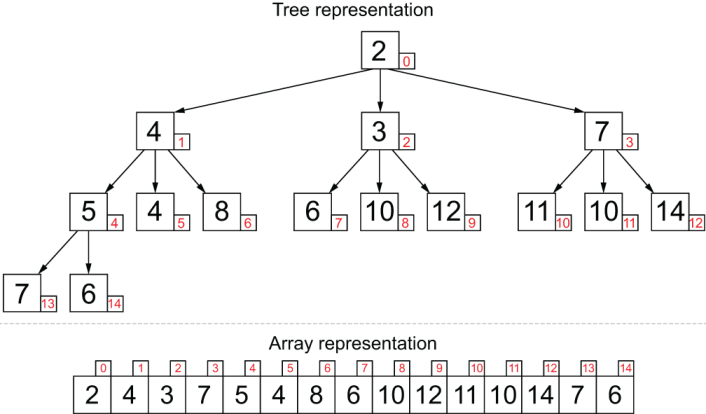
Compare the three-way heap's tree with its array: node indices make the child and parent calculations concrete. section 2.5.5
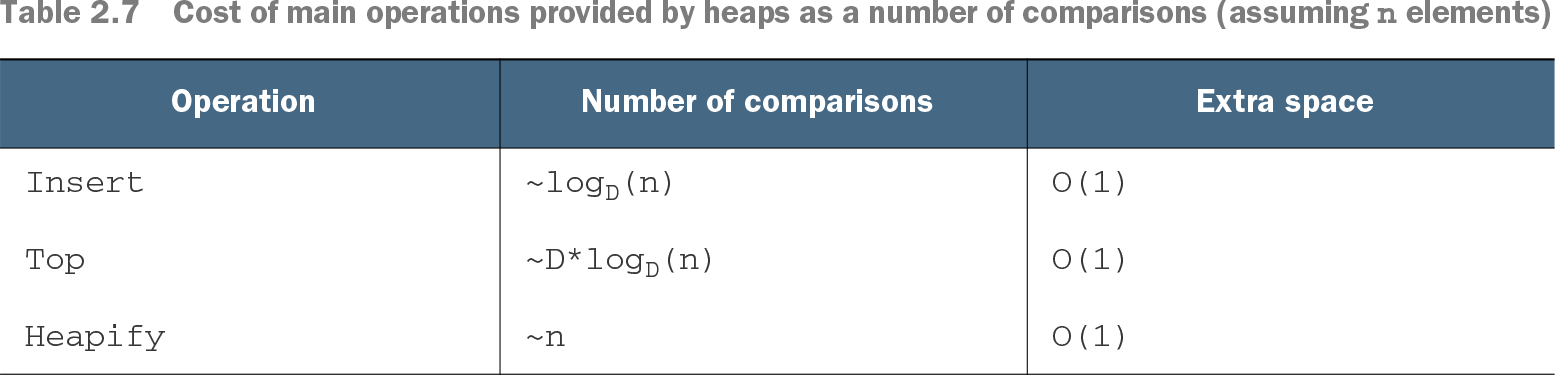
Increasing D makes the tree shorter: a heap of n elements has height about log_D(n). Insertion bubbles an item upward and checks roughly one parent per level, so its comparisons and swaps are about log_D(n). Removing the top item pushes an element downward, but must examine up to D children at each level. Its swaps are about log_D(n), while its comparisons can reach about D × log_D(n). An extremely wide heap therefore saves levels but can make removal nearly a linear search. section 2.10 section 2.9.2
Table 2.7 Cost of main operations provided by heaps as a number of comparisons (assuming n elements) (view table figure)
The comparison counts expose the central trade-off: insertion benefits from fewer levels, while top must also scan wider groups of children. section 2.10
Start with D = 4 as a practical candidate, not a universal optimum. The best setting depends on the mix of insertions and removals, the data, and implementation costs. Wider heaps may also improve locality when cache misses or page faults matter because children occupy clusters. Profile representative inputs and the whole application before committing to a value; faster heap methods need not produce equally large end-to-end gains. section 2.9.3 section 2.9.4 section 2.10.4
Choosing D for Huffman encoding
In one Huffman encoding profile, D = 9 gave the best observed overall time, while values above 7 were nearly as good. Even though individual heap-building steps improved much more, the main encoding method gained only about 5%. Treat that result as specific to the tested inputs, not as a default for other priority queues. section 2.10.4