Bridge priority is the 16-bit priority component of a spanning-tree bridge identifier (BID). It combines a configurable priority value with the Extended System ID, which equals the VLAN ID in Cisco STP. Because STP elects the numerically lowest BID as root, a lower bridge priority makes a switch more likely to become the root bridge for that VLAN. section 14.3.1 section 14.6
Figure 14.6 The contents of the STP BID. It is divided into two parts: a 16-bit bridge priority and a 48-bit MAC address. The bridge priority consists of two further parts: a configurable priority value (default 32768) and the Extended System ID, which is equal to the VLAN ID in Cisco’s implementation of STP.
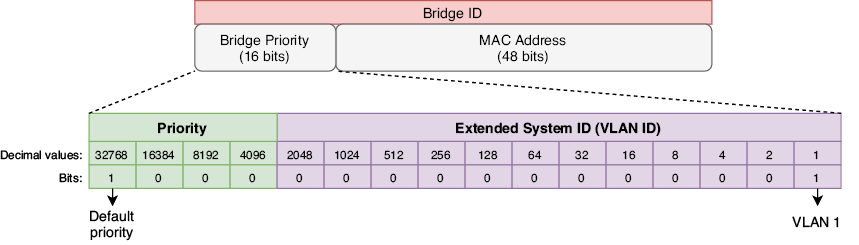
The BID layout shows how the 16-bit bridge priority contains the configurable value and VLAN-based Extended System ID, alongside the 48-bit MAC address. section 14.3.1
Key configuration and election points:
- The default configurable value is 32768; the VLAN ID is added to it. For VLAN 1, the displayed priority is therefore 32769. section 14.3.1 section 14.3.1
- Cisco accepts configured priorities only in increments of 4096, such as 0, 4096, 24576, and 32768. A value such as 20000 is rejected. section 14.3.1
- PVST+ maintains a separate spanning-tree instance for each VLAN, so a switch can have a different bridge priority and root role in each VLAN. section 14.3.1
- Use `show spanning-tree` to compare the root and local BIDs, and configure a VLAN with `spanning-tree vlan vlan-id priority priority-value`. section 14.6
Selecting a root bridge
Configuring SW3 with `spanning-tree vlan 1 priority 24576` gives it a displayed priority of 24577 after adding VLAN 1. SW4 configured at 28672 displays 28673, so SW3 has the lower BID and becomes root. If SW3 fails, SW4 becomes the next root candidate. section 14.3.1 section 14.3.1
