A broadcast storm is an excessive volume of broadcast or similarly replicated traffic that consumes network resources and can make a LAN unusable. It commonly results from a Layer 2 loop in a redundant switched network. section 14.6 section 14.1
Ethernet frames have no mechanism to discard looping frames. Switches flood broadcast, unknown unicast, and multicast traffic, so redundant links can replicate the same frame repeatedly. CPU resources, link bandwidth, and connected hosts may become overwhelmed within seconds. section 14.6 section 14.1
Recognize the related symptoms:
- Repeated frames consume bandwidth and device processing capacity. section 14.6
- End hosts receive identical frames repeatedly and may be overwhelmed. section 14.1
- MAC address flapping can occur as switches learn one address on multiple ports. section 14.1
Three-switch loop
PC1 sends a broadcast frame to SW1. SW1 floods it toward SW2 and SW3; both switches flood their copies onward, creating clockwise and counterclockwise loops. The frames continue circulating until the LAN becomes unusable. section 14.1
Figure 14.1 PC1 sends a broadcast frame, and SW1 floods it. When SW2 and SW3 receive their copies of the frame, they flood it too, resulting in two loops: counterclockwise (A) and clockwise (B). These frames will loop indefinitely between SW1, SW2, and SW3.
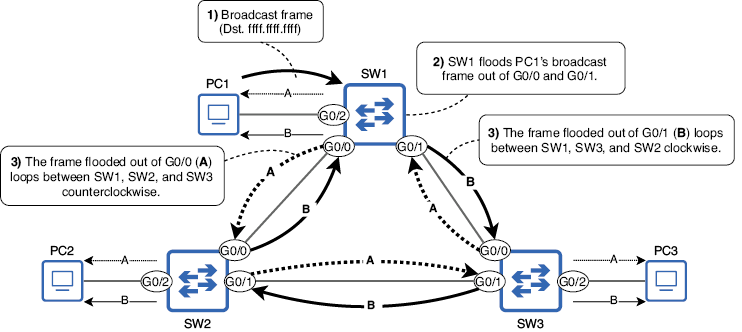
Trace the two paths created when SW1, SW2, and SW3 flood PC1’s broadcast frame. section 14.1
Spanning Tree Protocol prevents the storm by blocking redundant connections and leaving one active path to each destination. Its loop-free topology uses root bridge election, root port selection, and designated port selection; switches exchange BPDUs to make these decisions. section 14.6
