broker.rack assigns each Kafka broker a rack, availability zone, data center, or other location identifier. Kafka uses these identifiers to spread replicas across fault domains and improve tolerance of localized failures. section 16.1.4
Location awareness also supports locality for consumers. Since KIP-392, a consumer configured with client.rack can fetch from a nearby replica instead of always fetching from the partition leader; producers still write to the leader. section 9.1.2 section 16.1.4
Apply broker.rack with these operational considerations:
- Set location identifiers on all brokers before creating topics so Kafka can distribute new topic replicas as evenly as possible across locations. section 16.1.4
- Use distinct, genuinely independent racks or availability zones when possible; spreading brokers across labels that share infrastructure does not provide the same fault tolerance. section 16.1.4
- Expect existing topics to require a separate redistribution tool such as Cruise Control; broker.rack alone does not rebalance their replicas. section 16.1.4
- Balance resilience against network cost: stretched clusters across availability zones increase inter-zone traffic, while client.rack can reduce consumer traffic between locations. section 16.1.4
A stretched cluster across availability zones
Assign brokers location identifiers corresponding to their availability zones. When a topic is created, Kafka attempts to distribute its replicas across those identifiers. Consumers can set client.rack to fetch from a same-zone replica, while producers continue sending records to the partition leader. section 9.1.2 section 16.1.4
Figure 9.1 The consumers are consuming from the nearest replica (in the same rack), but producers still have to produce to the leader of the partition.
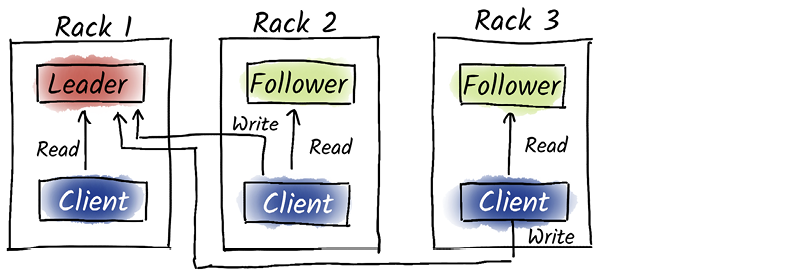
Visualizes consumers reading from the nearest replica while producers still communicate with the partition leader. section 9.1.2
Figure 16.2 In a stretched cluster, our Kafka brokers are distributed among multiple data centers.
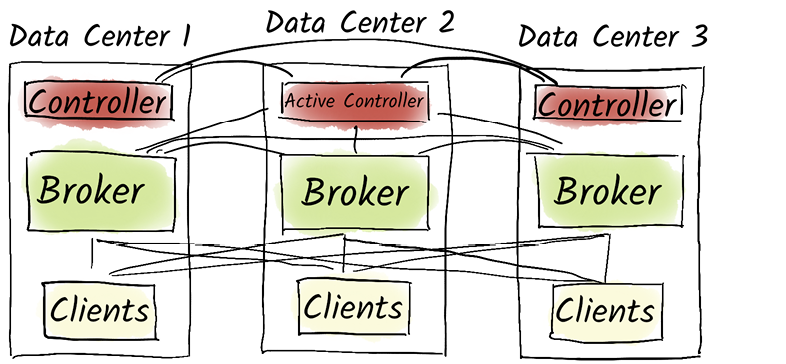
Visualizes brokers distributed across multiple data centers in a stretched Kafka cluster. section 16.1.4
