Emergent behavior is a capability or pattern that appears when a model becomes large enough, even though smaller models could not perform the task reliably. Large language models can suddenly solve tasks that smaller models handle no better than random, especially through zero-shot and few-shot prompting. section 2.4
In practice, scale can improve several related abilities:
- Few-shot learning: generalizing from only a few examples without task-specific fine-tuning or extensive labeled data. section 2.4
- Zero-shot performance: handling entirely novel tasks through prompting alone. section 2.4
- Language robustness: disambiguating words, interpreting varied input styles, and tolerating noisy or ungrammatical text. section 2.4
Figure 2.8 Examples of LLMs demonstrating emergent behaviors when given few-shot prompting tasks after the model scale reaches a certain size
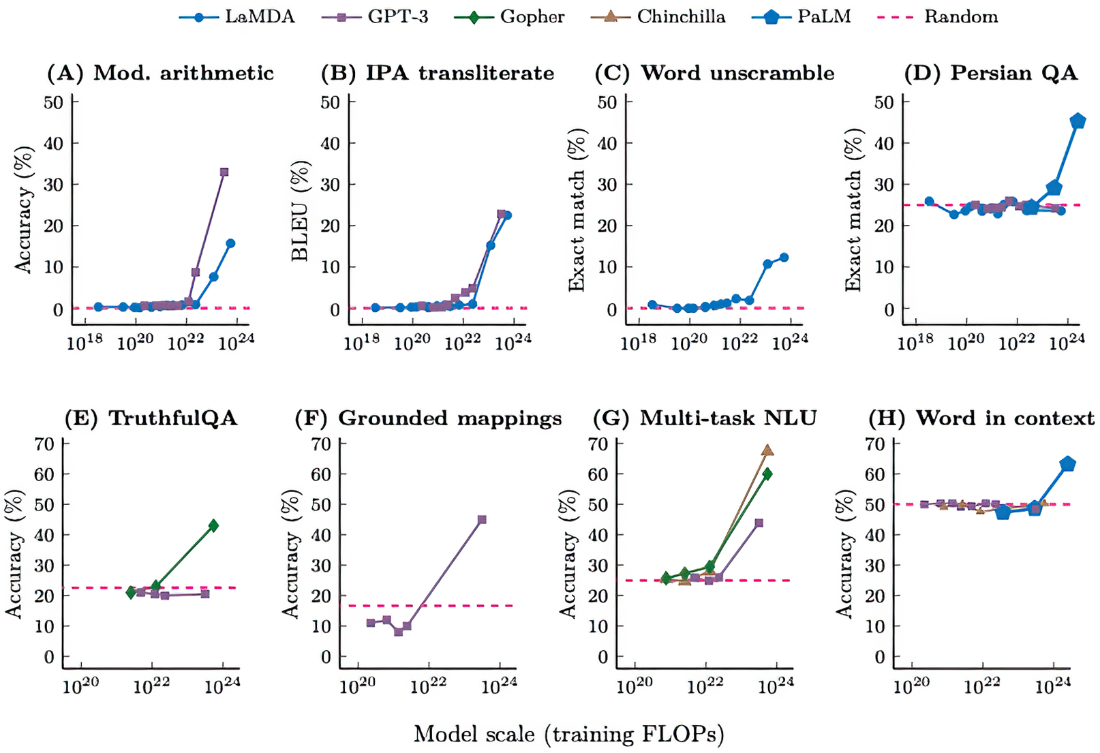
Use the figure to compare tasks that remain difficult at smaller scales with capabilities that appear after models reach a sufficient size. section 2.4
