Fusing mounts an object-storage bucket on a machine so it behaves like an external drive. For LLM serving, this lets application code load a model directly into memory instead of downloading it first. section 6.1.2
The convenience comes with operational trade-offs:
- It simplifies storage access but still pulls objects from multiple machines behind the filesystem interface. section 6.1.2
- Mounting storage in the same region and zone can improve performance, yet fusing has proved slow in practice—usually faster than download-then-load. section 6.1.2
- FUSE-based libraries support major cloud providers, Ceph, MinIO, laptops, and edge devices. section 6.1.2
Loading a model from a fused bucket
A serving node mounts a bucket as a filesystem and reads the model directly into GPU memory. The interface resembles local-disk access, while object retrieval remains distributed underneath. section 6.1.2
Figure 6.3 Different strategies for storing LLMs and their implications at boot time. Often, we have to balance system reliability, complexity, and application load time.
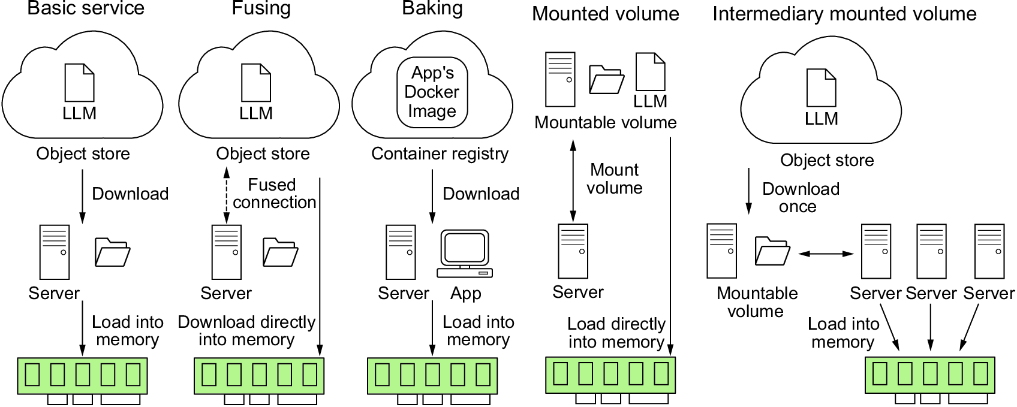
Compare fusing with other LLM-storage strategies through the reliability, complexity, and boot-time loading trade-offs. section 6.1.2
