An intermediary mounted volume downloads an LLM during boot, stores it on a mounted volume, and lets later instances load it without downloading again. The first deployment in a region gains no speedup, but subsequent instances can start substantially faster—useful when autoscaling must absorb bursty workloads. section 6.1.2
Use the strategy with these trade-offs in mind:
- Treat the volume like a storage cache: it improves later startup, but a total system crash can remove the speed advantage. section 6.1.2
- Avoid relying on it with only one replica; production deployments should tolerate instance or volume failure. section 6.1.2
- Balance faster boot times against volume coordination, replication, reliability, and infrastructure requirements. section 6.1.2
Autoscaling after the first deployment
A service downloads the model when its first regional instance boots and saves it to a mounted volume. When traffic creates additional instances, they mount that volume and load the existing model instead of downloading it again. section 6.1.2
Figure 6.3 Different strategies for storing LLMs and their implications at boot time. Often, we have to balance system reliability, complexity, and application load time.
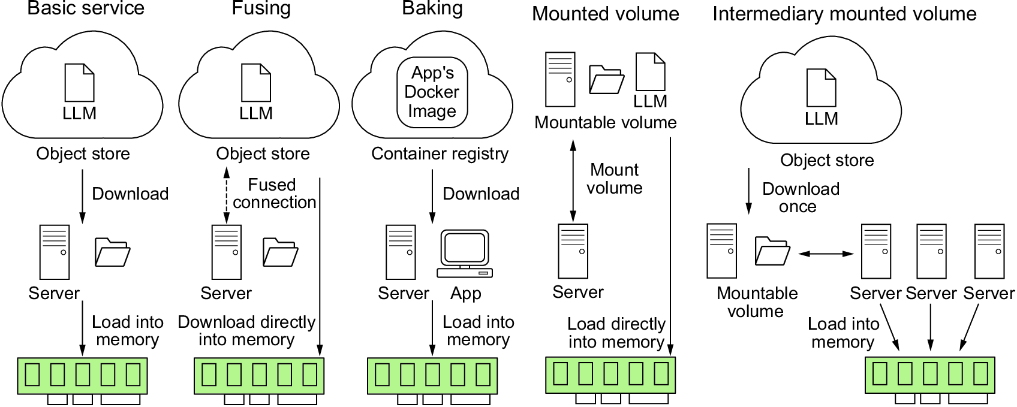
Compare mounted-volume storage with other LLM storage strategies by boot-time load, reliability, and operational complexity. section 6.1.2
