An LLM service packages a language model behind an API so applications can send requests and receive generated responses on demand. This turns a trained model into a live software component that can serve chatbots, batch jobs, streaming pipelines, or editor integrations. section 6.0 section 6.1
A practical service usually combines the model with an API layer that handles:
- Request preprocessing and retrieval-augmented generation (RAG) before inference. section 6.1
- Batching, rate limiting, and streaming to manage workload and responsiveness. section 6.1
- Deployment on a cloud cluster or an edge device, with explicit trade-offs in latency, efficiency, accuracy, memory, and cost. section 6.0 section 11.0
A small network service on a Raspberry Pi
A model server can expose an LLM on a Raspberry Pi for devices on the same home network. An existing application using the OpenAI Python bindings can target the local service by changing base_url and supplying the server's API key. The compatibility makes integration simple, but the Pi may produce only about five tokens per second, illustrating the gap between a working service and a useful enterprise deployment. section 11.0 section 11.3
Figure 6.1 A basic LLM service. A majority of the logic is handled by the API layer, which will ensure the correct preprocessing of incoming requests is done and serve the actual inference of the request.
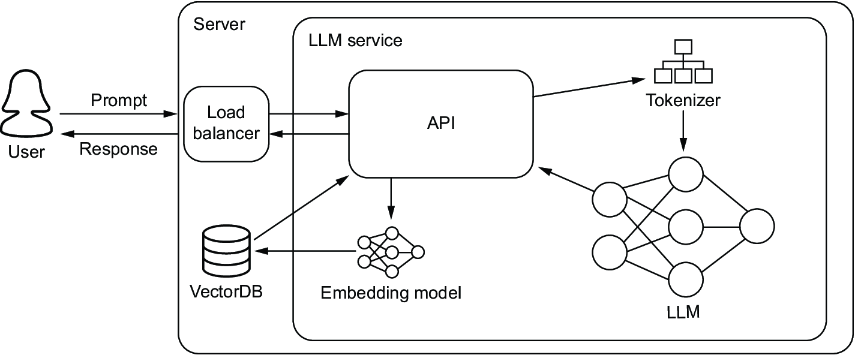
The architecture diagram shows the API layer coordinating request preprocessing and model inference, making the service boundary and its main responsibilities explicit. section 6.1
