liveBook · Manning

Browser farm

As explained in The Cloud at Your Service: The when, how, and why of enterprise cloud computing

A pool of browsers hosted on multiple machines for executing browser-based tests.

A browser farm is a pool of browsers hosted in the cloud to run functional tests in parallel. It adds machine-level parallelism when a build agent cannot run many resource-intensive Selenium tests at once. section 7.3.2

A typical setup:

  • Uses a central Selenium Grid server to allocate browsers from the farm exclusively to tests. section 7.3.2
  • Can shorten test feedback time, but the scale and speedup depend on running browsers in parallel rather than sequentially on one build agent. section 7.3.2

Faster test runs

A pool of 20 browsers per build agent is given as an example that can reduce a three-hour build to under ten minutes. section 7.3.2

Figure 7.7. Selenium tests running in parallel against a single test environment on a CI build agent
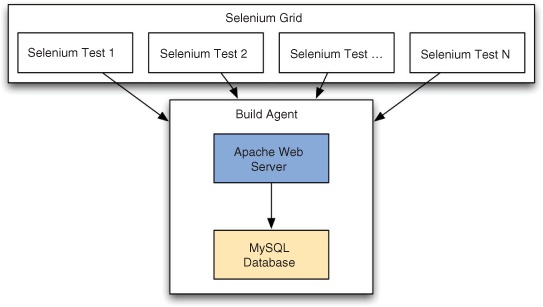
Illustrates Selenium tests running in parallel. section 7.3.2
How The Cloud at Your Service: The when, how, and why of enterprise cloud computing covers it

How deep it goes
Explains parallel browser allocation and its testing impact, but gives no setup procedure.
Examples
Compares a 20-browser pool with a three-hour build reduced to under ten minutes.
What it assumes
Assumes Selenium-based functional tests and build agents, contrasting their resource demands with unit tests.
What you can do after
Apply Selenium Grid to run browser-based functional tests in parallel and shorten feedback cycles.
How it connects
Connects Selenium Grid with Selenium, functional testing, and continuous integration.

Related concepts

This explainer was generated by Manning's knowledge graph from the text of The Cloud at Your Service: The when, how, and why of enterprise cloud computing. The section links point to the parts of the book it draws on.