Brute-force similarity search compares a query vector with every database vector, typically through dot products, to return exact nearest neighbors. Its cost is O(n × d), where n is dataset size and d is vector dimensionality. section 2.2.1
Its practicality depends on scale and response-time requirements:
- Small catalogs can support exact scans: roughly 6,500 128-dimensional movie embeddings require fewer than one million floating-point operations per query. section 2.2.1
- Enterprise catalogs make real-time exact scans impractical; billion-scale search therefore shifts toward Approximate Nearest Neighbor algorithms. section 2.2.1
- GPU acceleration can keep exact search practical for large applications, but latency, recall, and memory still require measurement. section 2.2.3
From a movie catalog to a global catalog
A single query can scan Netflix’s roughly 6,500-movie domestic catalog quickly, while scanning Amazon’s then-more-than-200-million-item global catalog in real time becomes unusable. section 2.2.1
Figure 2.2 What cosine similarity measures and discards. Top left: the query and doc A sit at angle θ, and doc B, twice as long and pointing the same way, scores identically, because normalizing removes magnitude before the dot product. The other three panels draw the values listed above: identical direction scores 1.0, right angles score 0.0, and opposite directions score −1.0, which text embeddings almost never produce.
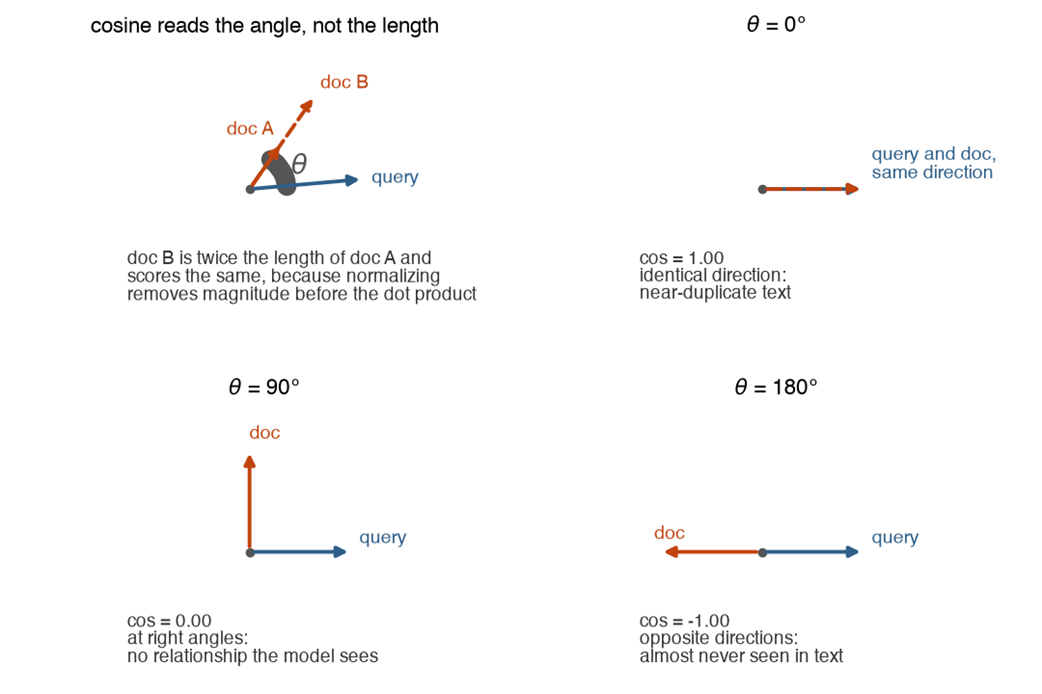
Shows how normalized vectors use direction for cosine similarity, including identical, orthogonal, and opposite directions. section 2.2.1
