A basic service set identifier (BSSID) uniquely identifies a basic service set (BSS). It is usually the MAC address of the access point’s radio, while the SSID is the human-readable network name and does not need to be unique. section 18.3.2 section 18.5
Use these relationships to identify a BSSID correctly:
- Each BSS has a unique BSSID, even when several BSSs use the same SSID as part of an extended service set (ESS). section 18.3.3
- One access point can provide multiple BSSs; each normally receives a distinct BSSID, often by incrementing the radio’s MAC address. section 18.3.2
- With one radio, those BSSs share the same channel, so multiple BSSIDs do not reduce channel congestion. section 18.3.2
- 802.11 frames can carry the BSSID alongside destination, source, receiver, and transmitter MAC addresses. section 19.1.1
Same SSID, different BSSIDs
An enterprise deploys three access points broadcasting “Jeremy’s Wi-Fi.” The SSID appears as one network to users, but each AP’s BSS has its own BSSID. As a client moves through overlapping cells, it can roam between those BSSs while remaining on the same ESS. section 18.3.3
Figure 18.15 An AP providing two BSSs for clients. Both use the same channel. Each BSS requires a unique BSSID. Hosts can only communicate within their BSS.
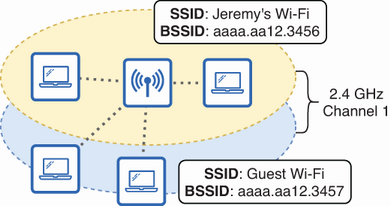
Use the figure to compare multiple BSSs supplied by one AP, their shared channel, and their distinct BSSIDs. section 18.3.2
Figure 18.17 An ESS consisting of three BSSs. Each BSS shares the same SSID, but has a unique BSSID. A client can roam seamlessly between BSSs.
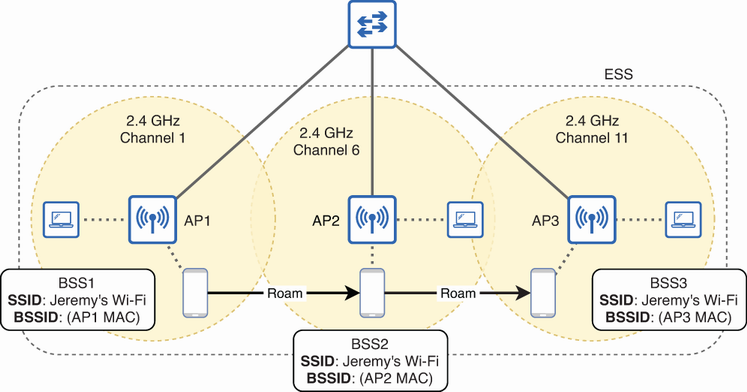
Use the figure to see how unique BSSIDs distinguish neighboring BSSs within one roaming ESS. section 18.3.3
