liveBook · Manning

Build settings

As explained in Building User-Friendly DSLs

Configuration data that specifies how source inputs and generated artifacts are transformed into a runnable system.

Build settings specify how generated business-knowledge code, handwritten Runtime code, and supporting components combine into a runnable or deployable Runtime artifact. section 8.5 section 8.0

A build system using these settings typically:

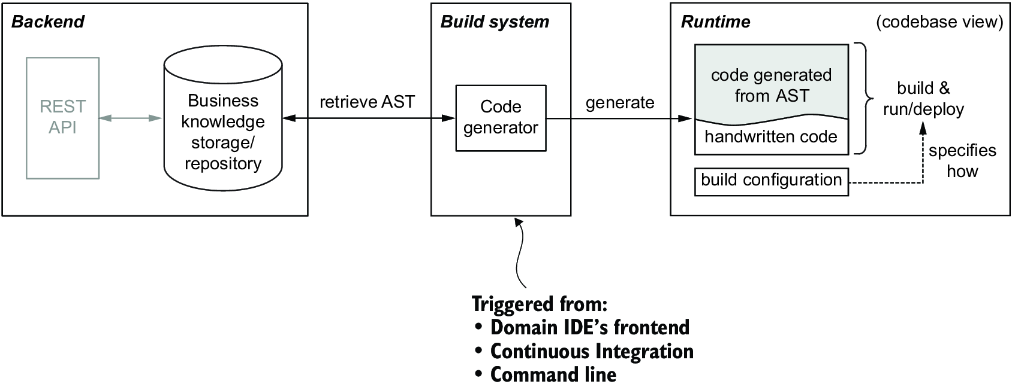
  • Retrieves the serialized AST from the business-knowledge repository. section 8.0
  • Feeds the AST to a code generator that produces valid Runtime code. section 8.0
  • Places generated code beside handwritten code and combines both into the Runtime build. section 8.1
  • Runs automatically after a CLI command, IDE action, or continuous-integration trigger. section 8.1

Rental Runtime

A rental-pricing DSL can generate the business-knowledge portion of a small web application. Build settings combine that output with handwritten application code and produce a runnable Runtime artifact. section 8.0

Figure 8.3 The architecture of the build system and Runtime
figure

Trace how the serialized AST, code generator, handwritten code, and build process fit together architecturally. section 8.0

How Building User-Friendly DSLs covers it

How deep it goes
Explains inputs, generated output, code combination, and trigger choices, but defers detailed build-tool configuration.
Examples
Uses a rental-pricing web application, serialized AST input, CLI builds, IDE build actions, and continuous-integration rebuilds.
What it assumes
Assumes DSL content, a serialized AST, handwritten Runtime code, and a defined Runtime architecture.
What you can do after
Operate/configure an automatic build that turns DSL-backed business knowledge into a consistently formatted Runtime artifact.
How it connects
Connects the AST, code generation, DSL content, Runtime architecture, continuous integration, and command-line builds.

This explainer was generated by Manning's knowledge graph from the text of Building User-Friendly DSLs. The section links point to the parts of the book it draws on.