The bulkhead pattern isolates system resources—such as thread pools, memory, or database connections—into compartments. If one service slows down or fails, it cannot consume capacity needed by the rest of the application. section 10.3.3
A slow payment service
Suppose an application has 100 processing threads. Assigning 80 to general web traffic and 20 to the Payment API means a stalled payment service can disrupt checkout without preventing users from browsing. section 10.3.3
A bulkhead contains resource exhaustion; it does not keep the affected service working. Unlike a Circuit Breaker, which cuts a failing connection, it limits how much capacity that failure can occupy. section 10.10 section 10.3.3
Figure 10.5 The Bulkhead Pattern. Just like a ship's watertight compartments, isolating your resources ensures that when one service floods and fails (Checkout), the damage is completely contained. The rest of your application remains healthy and afloat.
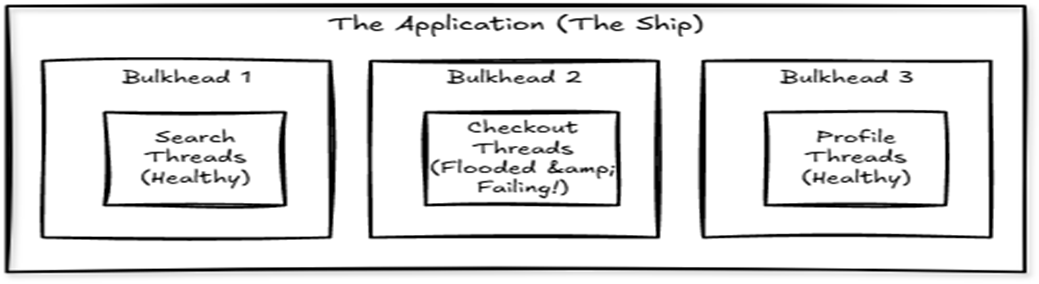
See how isolated compartments contain a checkout failure while the rest of the application stays healthy. section 10.3.3