BUM traffic means broadcast, unknown-unicast, and multicast frames that switches flood or replicate across multiple ports. In a redundant LAN, this flooding can create Layer 2 loops and broadcast storms. section 14.6 section 14.1
BUM traffic matters because:
- Redundant switch paths can cause flooded frames to circulate indefinitely because Ethernet provides no mechanism to discard looping frames. section 14.1
- Accumulating frames can overwhelm switch CPU resources, link bandwidth, and connected hosts, producing a broadcast storm or loss of service. section 14.1
- Spanning Tree Protocol prevents these loops by blocking redundant connections and leaving one active path to each destination. section 14.6
Three-switch broadcast loop
PC1 sends a broadcast to SW1. SW1 floods it toward SW2 and SW3; both switches flood their copies onward, creating clockwise and counterclockwise loops. section 14.1
Figure 14.1 PC1 sends a broadcast frame, and SW1 floods it. When SW2 and SW3 receive their copies of the frame, they flood it too, resulting in two loops: counterclockwise (A) and clockwise (B). These frames will loop indefinitely between SW1, SW2, and SW3.
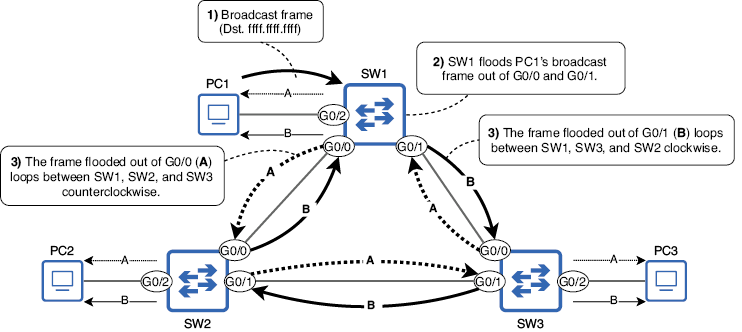
Trace how one broadcast frame becomes two circulating loops across redundant switch connections. section 14.1
