Business optimization formalizes decisions about operations and resource allocation. It most often fits recurring, operational decisions involving multiple entities that can be quantified; strategic choices are less suited when they are infrequent and qualitative. section 1.3
Common operational problems include:
- Retail inventory replenishment: choose order quantities across products and stores to balance ordering, holding, and stockout costs against service requirements. section 1.4
- Delivery routing: sequence visits across vehicles and customers to reduce distance, delivery time, or fuel use. section 1.4
- Manufacturing production scheduling. section 1.4
When decisions unfold over time in uncertain, changing conditions, reinforcement learning offers an adaptive approach: it learns from interaction and feedback, balancing short-term rewards with long-term outcomes. section 1.7
Figure 1.4 Framework for business optimization models.
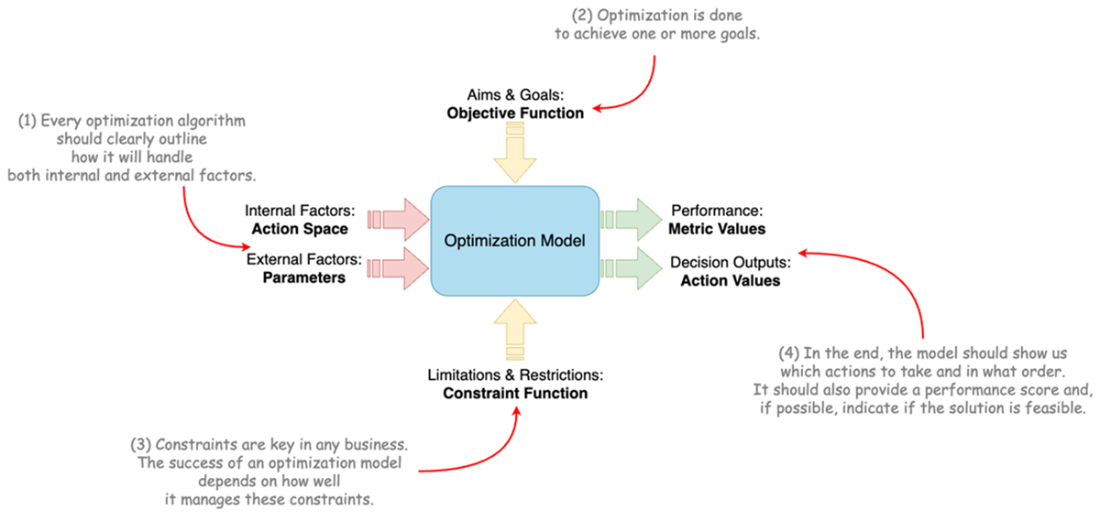
Use the framework diagram to orient the inputs and decision structure of a business optimization model. section 1.3
