C bindings expose a foreign library’s functions, types, and global variables to Rust as declarations and interface metadata, without including their implementations. They let Rust code cross the C FFI boundary and call libraries such as NGINX or OpenSSL. section 4.3
A typical binding workflow is:
- Create a C wrapper header that includes the foreign library headers required by the Rust integration. section 4.3.2
- Use bindgen from a Cargo build dependency and build script to parse declarations and generate compatible Rust code. section 4.3.2
- Restrict generated items with filters such as ngx_ prefixes to reduce unnecessary API surface and compilation cost. section 4.3.2
- Write generated bindings to the build output directory and include them with OUT_DIR before defining the Rust FFI function. section 4.3.2
Binding NGINX types
A Rust NGINX handler can include generated declarations, use ngx_http_request_t and ngx_int_t, and expose an unsafe extern "C" function with #[no_mangle]. The resulting dynamic library is linked into NGINX, which can then load the module and invoke the handler. section 4.3 section 4.3.2
Figure 4.1 High- and low-level Rust bindings for the openssl C library
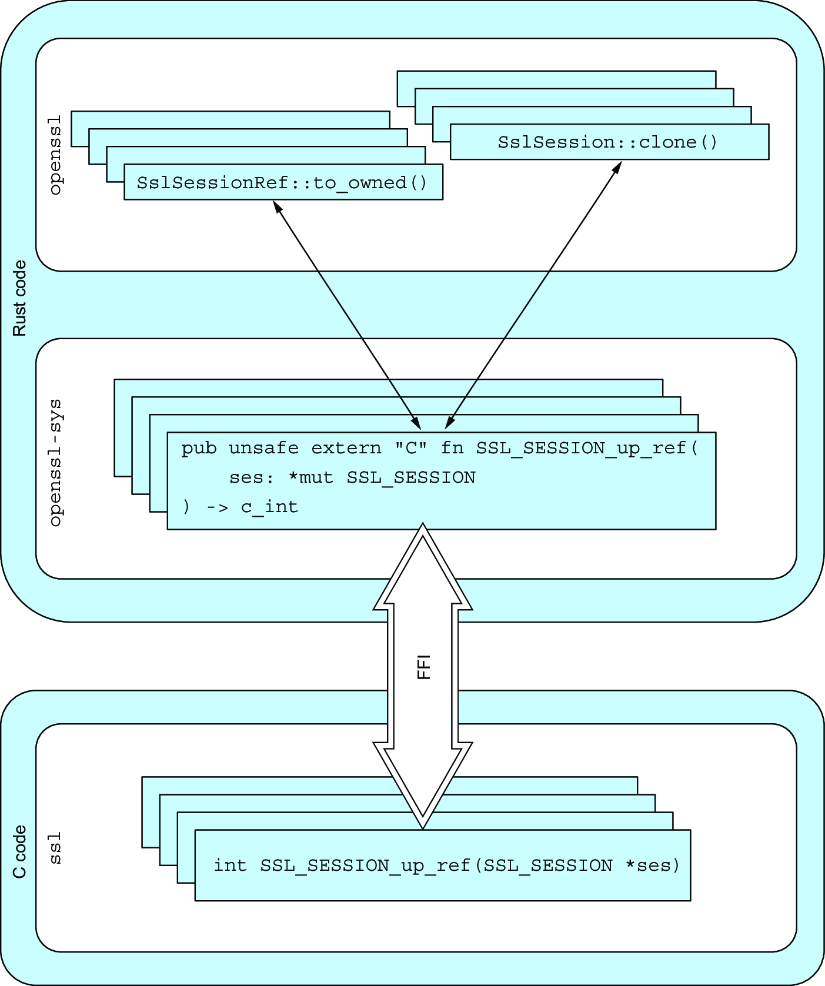
Shows the relationship between high-level Rust bindings, low-level generated bindings, and the OpenSSL C library. section 4.3
