A cache replacement policy decides which entry to evict when a full cache must make room for another. Fast storage is limited and expensive, so a cache usually holds only part of its backing dataset. The choice matters: evict an entry that is needed again soon, and the next access must pay the cost of fetching it from the backing store. section 6.6 section 6.5
Judge a policy by the workload it serves, not by its name alone. Cache hit ratio is the share of accesses served by the cache. A policy that preserves frequently needed entries can improve that ratio and reduce latency, but capacity also matters: a 1 MB cache cannot hold a 10 MB working set. Changing access patterns—for example, processing repeated passes in cache-sized batches—may help alongside changing the policy. section 6.5 section 6.6
Common approaches make different choices about which entry deserves to stay:
- FIFO evicts the entry added earliest, without promoting it on access. section 6.6.3
- LRU eagerly promotes an accessed entry to the head of the cache; LFU is another named replacement policy. section 6.6.3 section 6.11
- SIEVE builds on FIFO: it marks accessed entries as visited and checks that mark when considering an entry for eviction, avoiding the immediate eviction of some recently accessed entries. section 6.6.3
An eviction under SIEVE
Suppose a full cache has its eviction hand pointing at C. A lookup of C marks it visited. When a miss for D requires space, the hand checks C, clears its visited mark, and moves on. If B is next and unvisited, B is evicted and D is inserted. This defers C’s eviction without moving C on every hit. section 6.6.3
Figure 6.9 The SIEVE algorithm in action. The first-in, first-out (FIFO) replacement policy evicts elements based on when they were added to the cache. SIEVE is a variant of FIFO, which keeps track of cached elements that were accessed to avoid evicting hot elements.
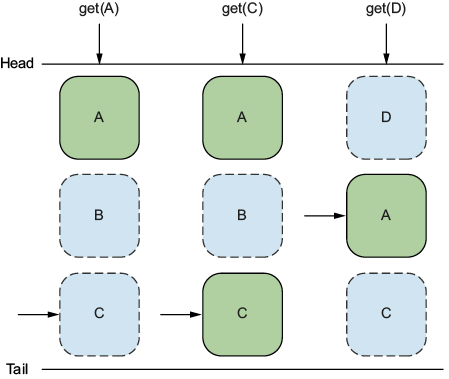
Follow the hand and visited marks through the SIEVE eviction sequence. section 6.6.3
Replacement is not the only cache decision. Entries may also need to expire because source values change. A time-to-live balances freshness against hit ratio: too short can cause unnecessary misses, while too long can leave stale data in use. section 6.2 section 6.11

