Candidate filtering is the fast first stage of a two-stage system: it quickly reduces a huge search space to candidates that a slower, sophisticated ranker can process. section 3.3
Use filtering to make downstream processing practical:
- Apply inexpensive predicates, such as matching some query words, instead of scanning billions of documents with sophisticated models. section 3.3
- Chain filters into a cascade, using query language or user location to remove unsuitable documents before later processing. section 3.3
Search engine cascade
A search system first filters documents with simple word-matching predicates, then applies sophisticated ranking to the smaller candidate set. Additional language and location filters can reduce it earlier. section 3.3
Figure 3.2 The process of problem decompositioning
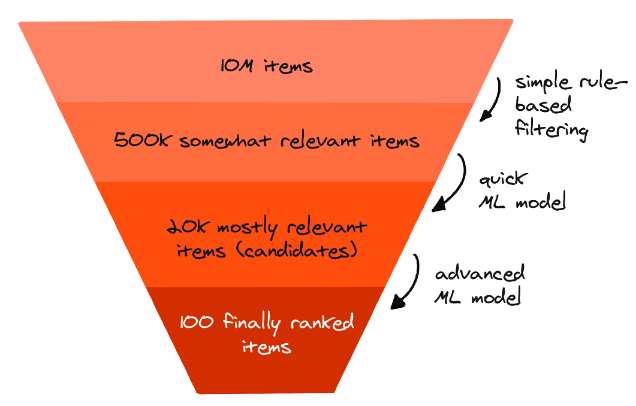
Trace how decomposition separates fast filtering from downstream processing. section 3.3
