Causal consistency links observed and counterfactual worlds: for a unit receiving treatment T, its observed outcome equals the potential outcome under T. In notation, the realized outcome is Y(T). This makes counterfactual reasoning preserve what was actually observed while allowing consequences of a different intervention to change. section 9.1.3 section 10.7.4
Consistency has practical consequences for causal models and identification:
- Keeps variables unaffected by an intervention equal across worlds, while variables downstream of the intervention may differ. section 9.1.3 section 9.4
- Creates perfect dependence between equivalent endogenous variables across worlds; ordinary d-separation on a parallel-world graph does not represent that dependence. section 9.1.3
- Allows equivalent variables to be collapsed across worlds, supporting ignorability arguments and derivations such as backdoor adjustment and SWIG-based identification. section 10.3.2 section 10.7.4
Counterfactual image editing
Given an image of a person wearing glasses, infer a latent representation, intervene to remove the glasses concept, and generate the edited image. A causal model should change downstream visual consequences while leaving unrelated conceptual content unchanged. The implementation uses a structural causal model with a variational autoencoder in PyTorch and the dSprites dataset. section 9.4
Figure 9.6 Paths for inferring the hypothetical distribution of I from the conditional distribution P(NG, NE, NI| E=“low”, I=50) on the exogenous variables, given the observed actual world outcomes
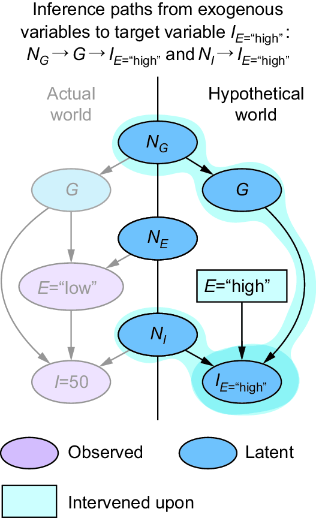
Trace how observed exogenous-variable information propagates to a hypothetical outcome after an intervention. section 9.1.3
