A causal factor is a variable or property that contributes to producing an effect. In a causal model, factors are treated as causes rather than merely predictive features. For an image, shape, scale, rotation, and position can independently determine visible properties; in decision systems, economic conditions can affect outcomes beyond the chosen action. section 9.4.1 section 12.1.2
Causal factors support several kinds of reasoning:
- Represent causes explicitly in a causal DAG, separating them from an image variable, utility, or other downstream effect. section 9.4.1 section 12.1.2
- Distinguish intervention questions from observational prediction: asking what would happen under a chosen action or changed factor requires causal reasoning. section 12.1.2
- Encode factors, infer image-specific exogenous variation, change one factor, and decode a counterfactual while preserving the inferred variation. section 9.4.1
- Treat representation learning cautiously: an unsupervised embedding may preserve reconstruction information without isolating causal factors. section 5.2.5
Changing a shape while preserving the scene
A dSprites image encodes shape, scale, rotation, and x- and y-position. Given an image of a square, infer its image-specific exogenous variable, replace the shape value with heart, and decode the intervened factor vector to generate the counterfactual image. section 9.4.1
Figure 9.18 The causal DAG for a dSprites image, displayed as a plate model to highlight the shape of NI and I. Ni is the exogenous variable for the image. The model is trained with an encoder-decoder framework that uses a 50 × 1 dimensional image encoding to represent NI.
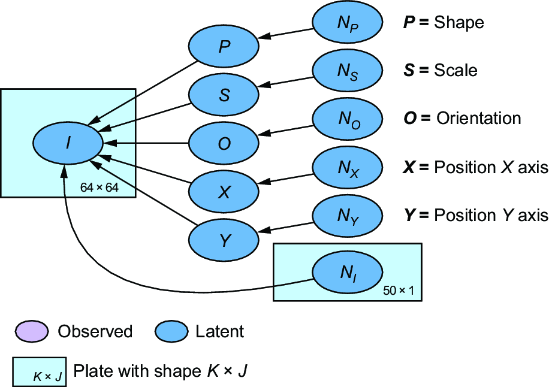
Use the causal DAG to inspect how causal factors and image-specific exogenous variation combine to produce an image. section 9.4.1
