An ad model may predict who will buy after seeing an impression. A causal machine learning model asks a different question: how would changing the impression affect engagement and, in turn, purchases? It combines learned relationships with a representation of what causes what, so predictions can support causal queries rather than only describe observed patterns. section 1.3.3 section 1.5.3
Figure 1.2 A model that captures how ad impressions drive engagement, which in turn drives purchases. This model decomposes into {ad impression, engagement} and {engagement, purchase}.
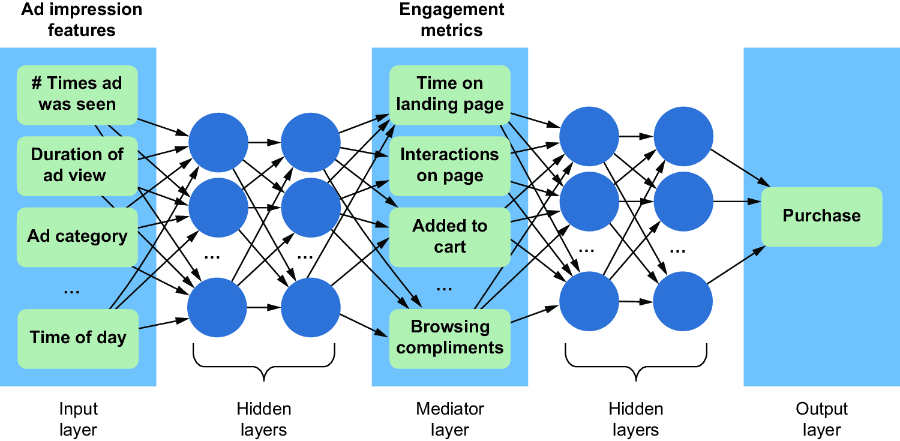
The ad-impression → engagement → purchase diagram shows how a causal structure separates one prediction problem into linked components. section 1.3.3
A practical workflow starts by stating the causal question, then representing possible causes mathematically, and finally fitting the model to data. A directed acyclic graph (DAG) can supply the structure. Its factors, or causal Markov kernels, can be implemented separately, composed into a probabilistic model, and fitted with standard statistical learning methods. For example, a kernel P(t | o, r) returns a probability for a queried value of T given O and R; the implementation can also generate values. section 1.5.3 section 3.1.7
The causal structure matters beyond answering interventions. Separating direct causes and effects makes the model decomposable; capturing a relationship that remains stable across settings may also help when deployed data drifts. Neither benefit removes the need to check assumptions: a causal answer must be identified by the assumptions and available data. section 1.3.3 section 3.1.7
