The causal Markov property connects a causal directed acyclic graph (DAG) to conditional independence. A node is independent of its non-descendants given its parents; equivalently, the joint distribution factorizes into conditional distributions given direct parents. section 3.1.6 section 3.5
The property has three equivalent formulations:
- Local Markov property: each node is conditionally independent of its non-descendants given its parents. section 4.3.1
- Markov factorization property: the joint probability distribution decomposes into parent-conditioned distributions. section 4.3.1
- Global Markov property: d-separation in the DAG implies conditional independence in the joint distribution. section 4.3.1
Ancestry and prediction
Grandfather and grandchild blood types are correlated through the father. Once the father’s blood type is known, the grandfather’s type provides no additional predictive information about the grandchild’s type. section 3.1.6
The assumption is operational: d-separations generate statistical tests for conditional independence, so failed tests can refute the proposed causal model. It also supports probabilistic parameterizations, including conditional probability tables, regressions, and neural networks. section 4.3.1 section 3.5
Figure 3.9 The causal relationships in the transportation DAG encode key assumptions about conditional independence.
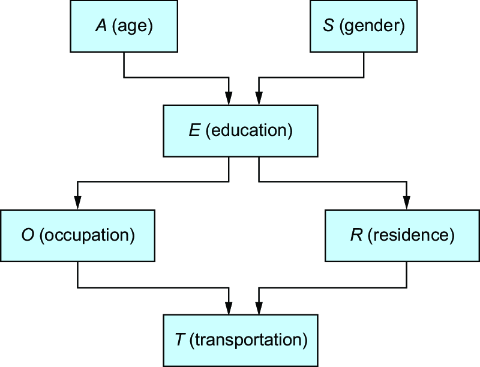
Use the transportation DAG to inspect how causal structure encodes conditional-independence assumptions. section 3.1.6
