Causal mathematics translates an intervention, explanation, or counterfactual question into a probability or expectation that can be estimated from data. It separates causal reasoning from ordinary prediction: first define the causal question, then formalize its target, then perform statistical inference. section 1.5.3
A practical workflow is:
- Pose the causal question: specify the intervention, outcome, conditions, or decision of interest. section 1.5.3
- Write the causal math: represent the question with causal notation, probabilities, or expectations. section 1.5.3
- Perform statistical inference: choose an analysis that estimates the formalized causal quantity. section 1.5.3
Conditional effects in causal MNIST
To estimate how writer type affects images of digit 4 at a specified stroke thickness, compare expected images under interventions setting writer type to “high school” and “bureaucrat.” Their pixel-by-pixel difference represents the conditional average treatment effect. section 1.5.3
Figure 1.8 Visualization of an example CATE of writer type on an image. It is the pixel-by-pixel difference of the expected image under one intervention (W="high school") minus the expected image under another intervention (W="bureaucrat"), with both expectations conditional on being images of the digit 4 with a certain level of thickness.
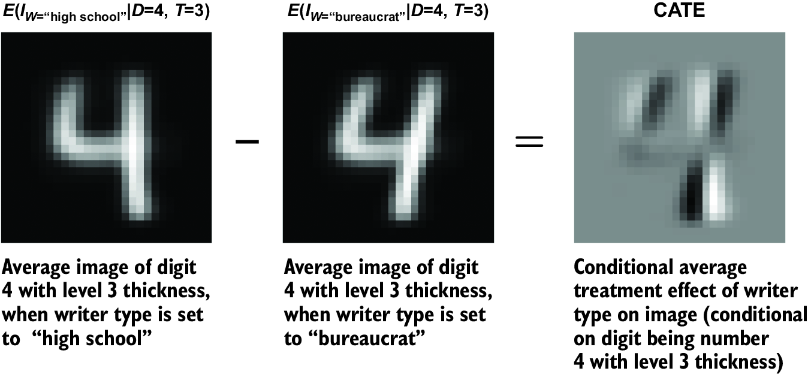
Visualizes a conditional average treatment effect as the pixel-by-pixel difference between two intervention-specific expected images. section 1.5.3
