The Cisco Certified Network Associate (CCNA) is Cisco’s entry-level networking certification and the exam required to earn it. It validates foundational knowledge of IP addressing, wired and wireless connections, routing, switching, services, security, and automation. section 1.1 section 1.5
Organizes exam coverage into six domains:
- Network Fundamentals — 20% section 1.1.1
- Network Access — 20% section 1.1.1
- IP Connectivity — 25% section 1.1.1
- IP Services — 10% section 1.1.1
- Security Fundamentals — 15% section 1.1.1
- Automation and Programmability — 10% section 1.1.1
Tests networking breadth rather than advanced specialization. The 120-minute exam uses single-answer and multiple-answer questions, drag-and-drop tasks, and lab simulations requiring Cisco router and switch configuration. Questions are randomly selected, and skipped questions cannot be revisited. section 1.1.2 section 1.5
Network scenario
A local-area network connects to the internet through highlighted routers, switches, and protocols such as DHCP and DNS. Studying the CCNA means learning how these devices and services work together. section 1.3
Figure 1.1 A local area network (LAN) connected to the internet (as represented by the cloud icon). Various devices (routers, switches, etc.) and protocols (DHCP, DNS, etc.) are highlighted. We will cover all of these technologies and more in this book’s two volumes.
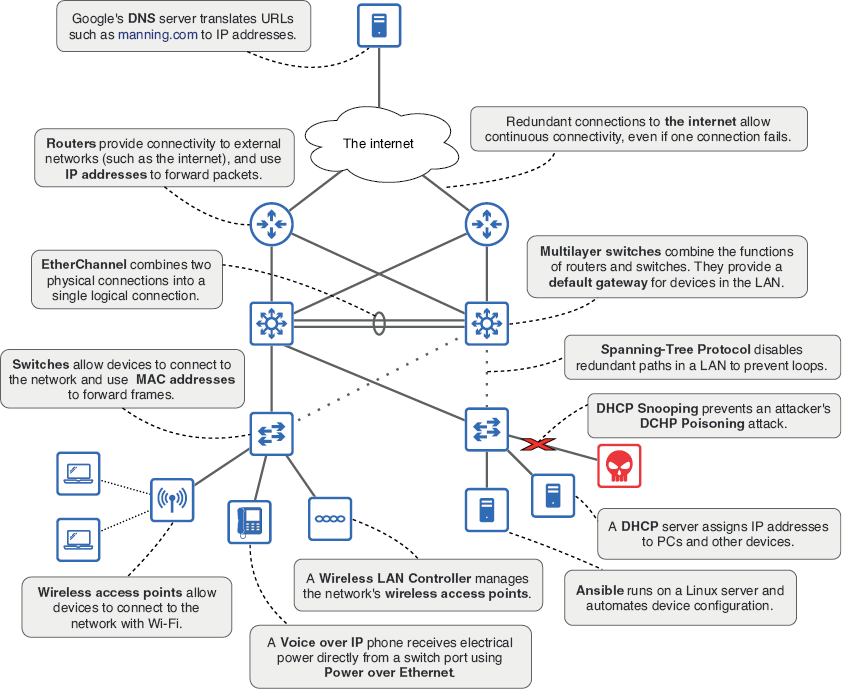
Use the network diagram to relate routers, switches, DHCP, DNS, and internet connectivity before studying each technology separately. section 1.3
Effective preparation combines sequential conceptual study with video instruction and practical labs using physical hardware, Cisco Modeling Labs, or Cisco Packet Tracer. Labs reinforce configuration and troubleshooting rather than memorization alone. section 1.4 section 1.5
