A cellular automaton represents a system as a grid of cells that update in discrete time steps according to rules. In a coffee-mixing model, each cell represents cream or coffee, and the initial grid separates them with a sharp boundary. section 8.1.1
Different rules represent different physical assumptions. In the interacting model, one adjacent cream–coffee pair swaps at a time, so particles cannot pass through each other. In the noninteracting model, each cream particle moves independently, and multiple particles can occupy the same cell. section 8.1.1
Figure 8.2 Illustration of the construction of the coarse-grained array using an example grain size of 3. The values of the shaded cells on the left are averaged to produce the value of the shaded cell on the right. Used with permission granted by the lead author (Scott Aaronson).
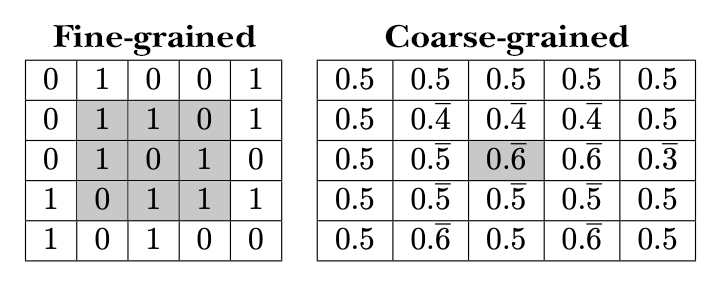
Averaging cells in small groups produces a coarse-grained grid that preserves large-scale patterns while smoothing away fine detail. section 8.1.1
