A misbehaving certificate authority could issue a malicious certificate and avoid revoking it. Certificate Transparency counters this by requiring issued certificates to appear in public logs, with proofs that browsers can check. section 9.3
The protection works as a monitoring-and-response loop:
- Certificate authorities add every issued certificate to a public log. section 9.3
- Browsers such as Chrome reject certificates lacking proofs of inclusion in a public log. section 9.3
- Domain owners monitor logs for unexpected certificates and ask certificate authorities to revoke them quickly. section 9.3
Spotting an unauthorized certificate
If a domain owner finds a certificate for their domain that they never requested, the public log exposes the mistake after issuance, enabling investigation and revocation. section 9.3
Figure 9.9 Certificate revocation on the web has had three popular solutions: Certificate Revocation Lists (CRLs), Online Certificate Status Protocol (OCSP), and OCSP stapling.
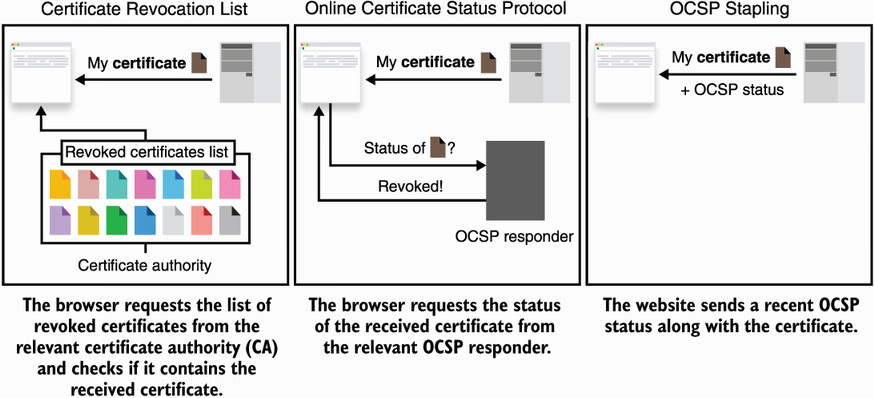
Compare Certificate Transparency with certificate revocation lists, OCSP, and OCSP stapling—the other prominent web revocation approaches. section 9.3
