A control plane extension adds capabilities that extend a system control plane’s API or resource-management behavior beyond its existing functionality. In Kubernetes platforms, extensions provision or configure resources beyond the Kubernetes API, such as external infrastructure. section 8.4.1 section 8.6
Extensions differ from control plane services. Services collect, analyze, and return or forward cluster and application state; extensions change what users can provision or configure. Keeping the categories distinct clarifies ownership, delivery pipelines, and operational maintenance as the platform grows. section 8.0 section 8.1
Storage classes and external resources
Managed Elastic Block Store and Elastic File System storage classes can remain standard AWS-managed features. A new storage technology, or an extension of those features, becomes a control plane extension when it extends the Kubernetes API or lets users provision resources outside the cluster. section 8.4.1
A practical platform starts by orchestrating extensions through a dedicated pipeline alongside control plane services. This supports sandbox and production environments, enables testing before release, and reduces overlapping maintenance work while the platform serves early customers. section 8.0 section 8.1
Common control plane extensions include:
- Storage classes for additional storage technologies. section 8.4.1
- Ingress and gateway APIs, resiliency capabilities, and authentication or authorization. section 8.6
- Service meshes for gateway APIs, routing, traffic policies, and zero-trust networking. section 8.6
Figure 9.1 Practical examples of evolutionary scaling strategies for engineering platform components
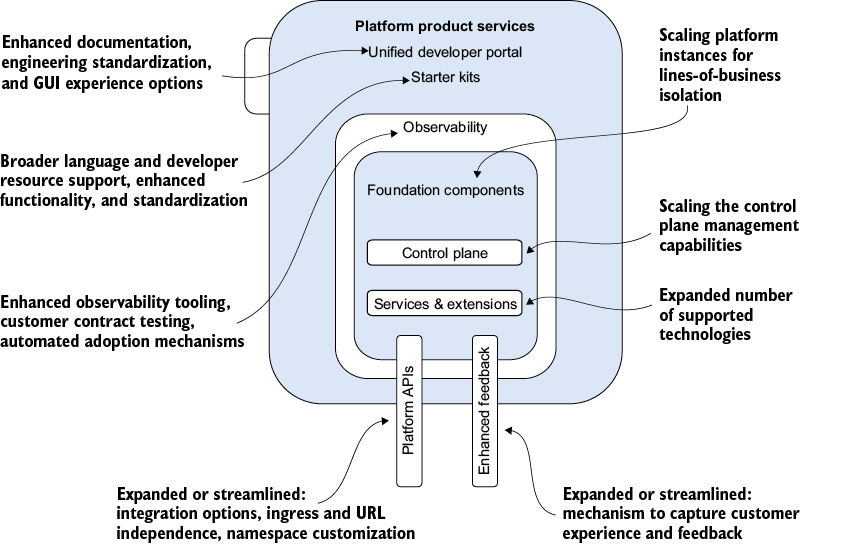
Use the scaling strategies figure to compare when control plane extensions should support priorities such as public API gateway integration. section 9.0
