A customer identity abstraction layer decouples platform-user identities and permissions from underlying infrastructure identities. It lets a platform provide flexible, self-service access without mapping every person directly to servers, storage, and other resources. section 4.3.3
The pattern addresses recurring identity and authorization problems:
- Avoids brittle one-to-one mappings between platform users and infrastructure resources. section 4.3.3
- Centers authorization on development teams while individuals remain the authenticating subjects. section 4.3.3
- Uses the identity provider as a go-between rather than the sole source of truth, allowing authorization results to be customized. section 4.3.3
Platform integration scenario
A platform may centralize access across SaaS products while an integration orchestrator maintains team information and publishes events for downstream integrations. Developers receive the resulting access through a product-like workflow instead of discovering infrastructure resources and completing manual requests themselves. section 4.3.3
Figure 4.8 We want the IDP to be the go-between rather than the source of truth, and we will need to be able to customize the results from the authorization service.
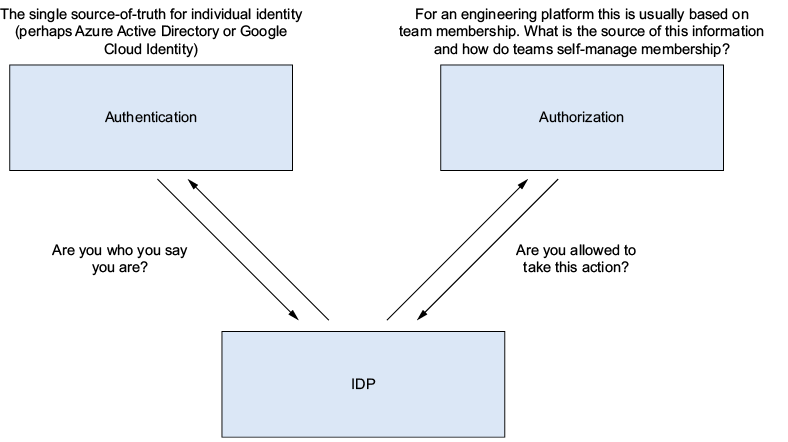
Use the architecture figure to inspect the identity provider’s intermediary role and the need to customize authorization-service results. section 4.3.3
