A dumb pipeline limits workflow logic to ordering and invocation. Git-triggered steps call reusable, versioned pipeline code—such as CircleCI orbs, shell-script libraries, or local scripts—for implementation details. section 6.3.3
This separation keeps standardized pipelines DRY across teams and helps developers pass shared compliance checks. It also preserves the ability to replace the pipeline tool without rewriting implementation logic. section 6.3.3
Namespace-level infrastructure pipeline
A platform team can trigger a pipeline from a Git event, retain only its secret-access credential in a CircleCI context, and delegate infrastructure behavior to shared versioned code or pipeline-specific local scripts. section 6.3.3
Figure 6.10 Well-architected Infrastructure-as-code pipelines are no different from well-architected regular software pipelines. This is why we prefer the term “software-defined infrastructure” to differentiate between simply using an infrastructure-as-code (IaC) framework like Terraform and the software engineering practices that are a part of sustainable, high-quality software developer lifecycle management of an engineering platform product.
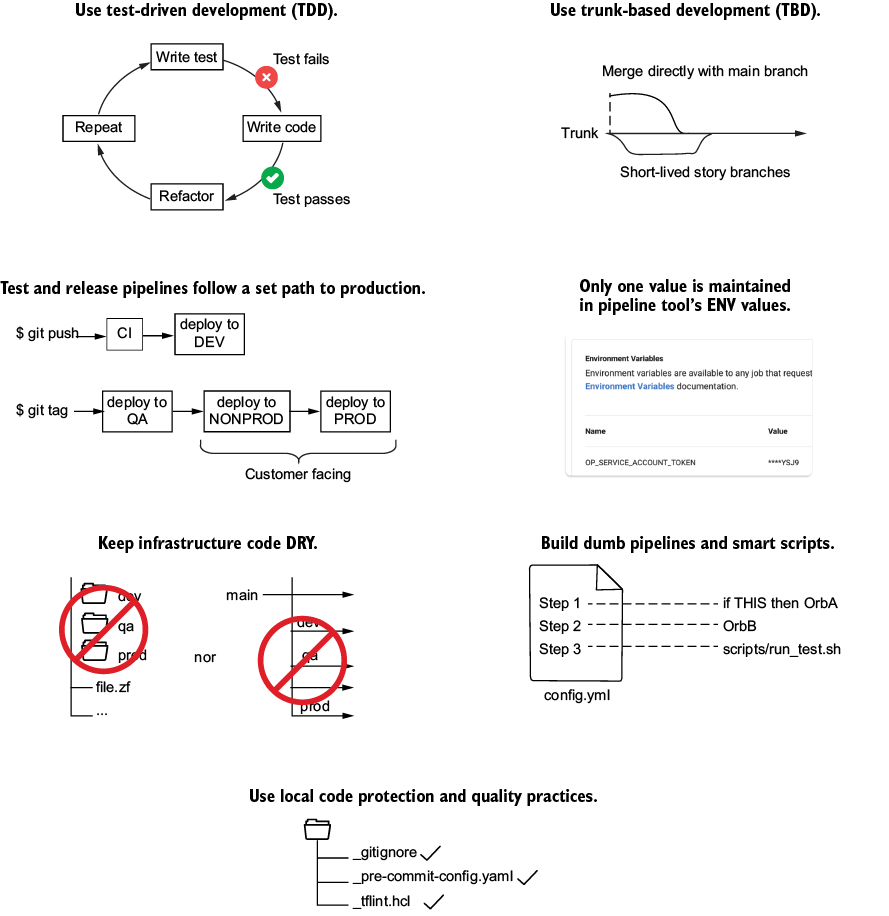
Relates dumb pipeline design to well-architected software and infrastructure-as-code pipelines, emphasizing software-engineering practices over framework choice. section 6.3.3
