A namespace API ensures that each team has the required namespaces and resource configuration in designated clusters. It turns platform policy into a resilient control-plane interface rather than leaving developers to perform manual, cluster-by-cluster setup. section 8.5 section 4.3.3
A practical implementation uses the API to:
- Maintain standard team namespaces across nonproduction and production clusters. section 8.5 section 4.3.3
- Apply resource allocations, Istio annotations, and other policy-defined settings. section 4.3.3
- React to team synchronization events and continuously reset drifted configuration to the desired state. section 4.3.3
- Support custom namespaces while allowing other integration services to subscribe to the same team event stream. section 8.5 section 4.3.3
Team onboarding
When a team is onboarded or modified, the Teams API emits a synchronization event. The namespace API uses that event to create or repair the team's namespaces in production and nonproduction clusters, applying the required allocations and annotations. External changes are corrected during subsequent checks. section 4.3.3
Figure 8.9 A “teams” API can be the interface to onboard a team and maintain the authoritative database for customer teams. This API will maintain the correct RoleBindings on the respective clusters. It can also populate the “sync team” events stream to which other services can subscribe.
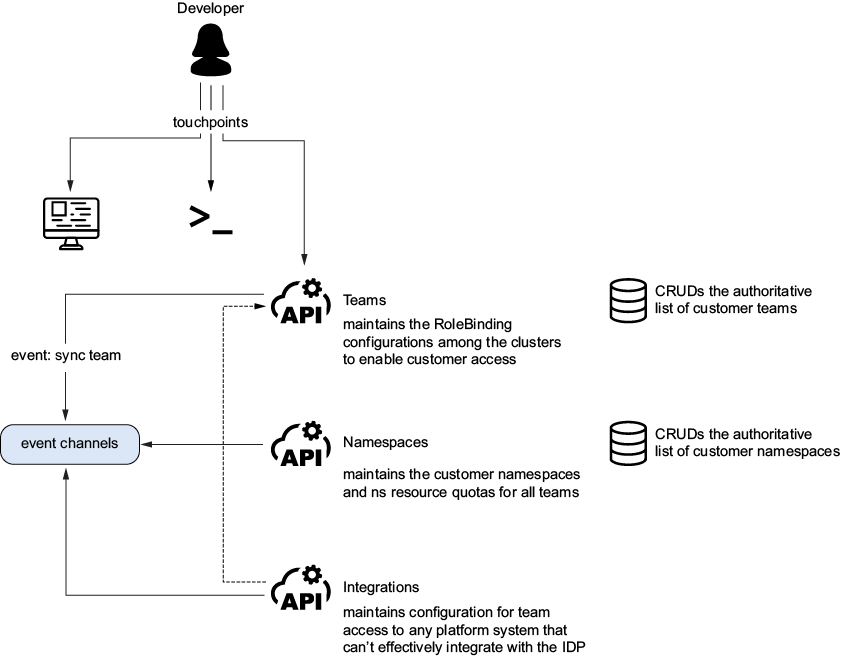
The architecture figure shows the related Teams API maintaining authoritative team data, correcting cluster RoleBindings, and publishing synchronization events for subscribing services. section 8.5
