A namespace-level pipeline is an automated delivery path that deploys an application and its associated resources into a particular namespace. For platform users, each environment in the path to production is represented by a Kubernetes namespace. section 6.3.3
A typical path moves through development, QA, and staging before production. A separate preview namespace and cluster lets platform teams test control-plane changes against real user services without disrupting their normal development flow. section 6.3.3
Payments team
A Payments team can deploy through development, QA, and staging while platform changes are tested separately in its preview namespace. This exposes failures against real services before production release without blocking the team’s usual path. section 6.3.3
Figure 6.9 For users of the platform, an environment in the path-to-production is a Kubernetes namespace. There will be one or more namespaces in a preproduction cluster, or eventually multiple clusters, where development teams test their application before deploying to a production cluster. Something you may not have seen before is the preview environment in the similarly named preview cluster.
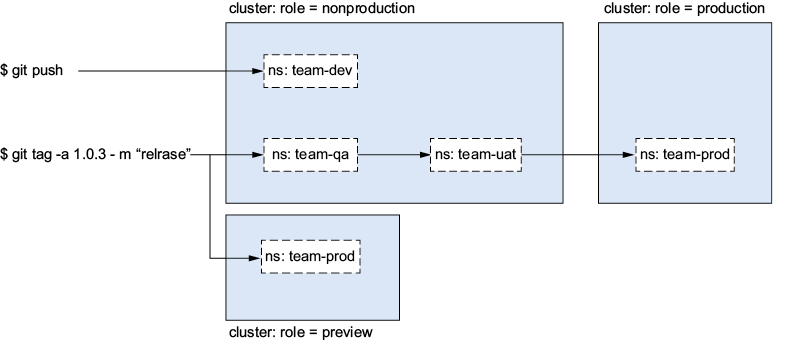
Use the environment diagram to compare namespaces across preproduction, production, and preview clusters. section 6.3.3
